In my teenager, some of my friends chose social science rather than science to avoid maths courses in college. The stereotype is that social science, such as history, literature, sociology and political science does not require quantitative skills, but qualitative ones, like writing reports and communicating with people. However this looks no longer true. Economics, together with its loyal partner - statistics, has dominated social science methodologies. The first time I read a political science paper inundated with regressions, I thought I found the wrong paper, but now I'm so used to mathy papers of this kind. Obviously numbers are widely applied in social science research, like developing index to evaluate the quality of democracy/dictatorship evaluating policy impacts, and using numbers to show the demographic changes in history, etc. Recently I even found a "poem-making" software which analyzes Chinese poems from Tang Dynasty, identifies the most popular words and phrases and reorganizes them into new poems. Some people acclaimed that this sort of software will put an end to social science, which sounds like a paranoid sleep talk by those with little idea of arts and literature.
It's true that in an information era, traditional way of studying social science may not be sufficient enough. Case studies, which used to be widely applied, are now considered to be biased samples; and causalities between two events are less convincing without excluding other factors rigorously. Interviewees can lie, interviewers can be biased, and it looks like in research the only reliable source is data. The development of data-processing software also makes it easier to do research with large data set. Therefore social science scholars and students, no matter how difficult it is to quantify their research objects, are trying to establish a database and use statistical models to reach certain conclusions. I won't say it's wrong - I've spent the last few years learning these skills, but there are several things that should be kept in mind in data work, especially for policy students.
One concern is that data can "lie" too. If you've worked with STATA, you may have noticed that conclusions can be very different when you use different regression function forms, different control variables or whether to cluster/stratify or not. From time to time, we need to use our common sense and logic to choose the one most likely to be true. However if we come across something that we're not familiar with, then how can we decide if we've handled data in the right way? It's quite common that people have different stances on the same issue even if they happen to use the same data base. Moreover, data analysis always requires a few assumptions, based on which our conclusions can be developed. However, because so many variables (either measurable or not) exist in the real world, that sometimes it's very hard to exam whether your assumptions hold or not. Tons of arguments arise in this field, and researchers are still fighting against each other when new variable/evidence emerges.
Another concern is that when numbers are large, we can easily be misled. If you think about 0.001% of the population, you may think of only a few people; but when you are referring to 13,900 people in China, that's not a small group. Number itself is not enough to display the full picture. On contrary, numbers can be cunningly used to hide the facts.
In addition, obsession with numbers is almost as bad as ignoring numbers. Though it's important to see policy impact on large groups, and therefore exam its effectiveness by looking into the joint benefits received by the population; single cases are vital too. If you think about how policy changes such as the abortion of racial segregation in the US, or how big event happens such as the start of WW1, a single case makes all the differences. There are a lot of psychological studies on cases vs. numbers, and case studies tend to impress audiences more. This is not surprising: after reading an article/report, which can you remember, numbers or stories?
People talk a lot about big data these days, and sometimes I can't help wondering how I look like in those companies' eyes - maybe a few dummy variables to identify my race, gender and consumption preferences, etc, and a few logit regressions to find out what coupons can induce a new purchase record from me - simple and straightforward.
Showing posts with label Abroad. Show all posts
Showing posts with label Abroad. Show all posts
Sunday, December 9, 2012

Wednesday, November 28, 2012
Black Friday
I don't know how many people still go to outlets/groceries on Black Friday given the rapid development of online shopping and regular promotions across the year. After reading all the terrifying stories about queuing, trampling and parking wars on Thursday night, fatigue driving and traffic congestion on Friday, I decide to avoid the war and go on Saturday, which also turned out to be a terrible idea. The newly opened outlet in Livermore was packed with happy shoppers, and it took at least 15 min for us to find a parking space, and another 15 min to get a fitting room in Banana Republic. Impressed with the long line outside ladies' room and the crowd in the food court, we went home with a few new clothes, whose prices were found to be lower through online shopping later.
That's when I started to doubt how important the Black Friday is in nowadays when retailers have thousands of ways to promote sales. I can see in old days, when people learned about sales from local ads and had to prepare Christmas gifts, Black Friday became a good shopping opportunity for the family. But now, as the population booms, the non-monetary cost of shopping on Black Friday has increased, while other choices, i.e. online stores, with good discount and no crowd seem to be a better choice; and following promotions, such as Cyber Monday, also attract a few customers.
But people still flock into stores on the very day, blocking the highways exits and swarming malls. Habit is a second nature. Black Friday, created by shrewd businessmen, has become a tradition over years and taken as an important family activity. Probably people do not come only for shopping, but to enjoy some family time together. Once shopping becomes a tradition, other than a pure economic behavior, it's difficult to abstain from doing it, especially when surrounded by family members and friends. When I think about why we decided to go shopping during the holiday, it was partly because we wanted to show how Thanksgiving looks like in the US to some visiting students from China; and partly because we wanted to enjoy sometime with each other without harassment from work and computers.
Chinese businessmen learned from their American counterparts and turned Nov 11 into Chinese Black Friday. Nov 11 was named as "Single's Day" by college students since a few years ago as "1" is the loneliest number in the world. In the latest Single's Day, Chinese biggest online shopping website, Taobao started a one-day sale, which created a historical sales record of CNY19.1 billion. It looks like Chinese business people learned from the lessons in the US Black Fridays, and carefully avoided stampedes given Chinese big population by offering online sales instead of in-store ones. Nevertheless, the panic online purchase still slowed down internet and created some chaos, though luckily no one was physically hurt. In light of the big success of Single's Day Sale, it may evolve into a new shopping tradition, just as Christmas and Valentine's Day Sale in China.
I used to shop a lot in college, but become much less motivated in recent years. Maybe in the future, when my kids and parents want to experience some craziness in the US, I will still bring them to a mall, and celebrate a Black Friday together.
That's when I started to doubt how important the Black Friday is in nowadays when retailers have thousands of ways to promote sales. I can see in old days, when people learned about sales from local ads and had to prepare Christmas gifts, Black Friday became a good shopping opportunity for the family. But now, as the population booms, the non-monetary cost of shopping on Black Friday has increased, while other choices, i.e. online stores, with good discount and no crowd seem to be a better choice; and following promotions, such as Cyber Monday, also attract a few customers.
But people still flock into stores on the very day, blocking the highways exits and swarming malls. Habit is a second nature. Black Friday, created by shrewd businessmen, has become a tradition over years and taken as an important family activity. Probably people do not come only for shopping, but to enjoy some family time together. Once shopping becomes a tradition, other than a pure economic behavior, it's difficult to abstain from doing it, especially when surrounded by family members and friends. When I think about why we decided to go shopping during the holiday, it was partly because we wanted to show how Thanksgiving looks like in the US to some visiting students from China; and partly because we wanted to enjoy sometime with each other without harassment from work and computers.
Chinese businessmen learned from their American counterparts and turned Nov 11 into Chinese Black Friday. Nov 11 was named as "Single's Day" by college students since a few years ago as "1" is the loneliest number in the world. In the latest Single's Day, Chinese biggest online shopping website, Taobao started a one-day sale, which created a historical sales record of CNY19.1 billion. It looks like Chinese business people learned from the lessons in the US Black Fridays, and carefully avoided stampedes given Chinese big population by offering online sales instead of in-store ones. Nevertheless, the panic online purchase still slowed down internet and created some chaos, though luckily no one was physically hurt. In light of the big success of Single's Day Sale, it may evolve into a new shopping tradition, just as Christmas and Valentine's Day Sale in China.
I used to shop a lot in college, but become much less motivated in recent years. Maybe in the future, when my kids and parents want to experience some craziness in the US, I will still bring them to a mall, and celebrate a Black Friday together.
Monday, November 26, 2012
Which Story is True
When I started to write this blog, I intended to make it like a diary with daily updates. Unfortunately I seemed to have overestimated my resolution in keeping writing - the last update was about 10 days ago. I did get very lazy during the holiday season. Our Thanksgiving holiday started with a five-course dinner with Leslie, who came to the bay area to spend the holiday with her sister on Wednesday. We joined a friend and her family in having a great seafood hotpot instead of turkey at her place Thursday night, when I cooked HongShaoRou (红烧肉), their most-missed dish from me. The next day was a sunny day, so Gang and I hiked in Point Reyes, and ate apples by the sea (as what we did in Hawaii). Saturday was the "shopping day", when we spent the entire afternoon in the newly opened outlet in Livermore, and finally bought a pair of matching sweaters, one for Gang and the other for me. The long weekend ended with another hotpot last night, when a friend brought all the raw materials and pots over to my place and played SanGuoSha, a popular board game in China for hours.
But the highlight of the holiday, at least in my opinion, is the movie we watched yesterday, Life of Pi, directed by Ang Lee. It's the best movie I've watched this year. It's similar to Li's previous movies such as Lust Caution and Crouching Tiger Hidden Dragon in terms of the heated discussion it has already triggered; though it's different in the sense of its new topic. I couldn't help wondering which story is true - the one counting for more than 80% of the entire movie about how Pi co-existed with the tiger during the adventure, or the one explaining how four people in the lifeboat killed and even ate their partners to survive. If the movie had finished ten minutes earlier, I'd happily buy the idea of this drifting adventure with animals, supported by beautiful scenes of the sea and fish stocks. But the second story, if true, turns the entire adventure into a disgusting struggling for survival.
Let's examine the assumptions one by one. If the first story is true, what looks discordant in the movie includes:
- The long introduction of his name, which in my understanding has two implications - 1) it's hard to tell the real story on the face of it; 2) it's hard to understand/explain a human being, just as you can't exhaust writing Pi no matter how hard you've tried;
- The rude French chief and the Buddhist sailor on the ship, who barely appeared later. If the entire story is about Pi and animals, why bother to mention these two in the movie?
- The locked cage and escaping animals. It's clearly shown in the movie that animals are locked in cages, and it's hard to imagine when the ship sunk and most people were unable to escape, these animals could get rid of locks and jumped out.
- On the floating island, when Richard Parker was eating a meerkat, other meerkats didn't get panic or escape. Also, the flower with human tooth and the acid water didn't make much sense in the real world. (There is an article on internet saying meerkats can never appear in that part of the world.)
- Most importantly, if the first one is true, why the movie spends so much time showing how Pi told the second story to the two Japanese investigators with so many details included? Since Pi was only asked to tell a story about the sunk of the ship, he didn't have to provide such a detailed story.
If the second one is true, all the above the irrational plots can be explained. But the only question I have is why? What's the point of telling an inhuman story in such a beautiful way? I'm an atheist, and I simply don't understand how people can still believe in God after surviving this.
Whatever the true answer is, Ang Lee is successful, and his movie makes audience think about the movie, and wonder what's the tiger in their heart. Great movie, recommend without reservation, though it does bother me for a long time.
But the highlight of the holiday, at least in my opinion, is the movie we watched yesterday, Life of Pi, directed by Ang Lee. It's the best movie I've watched this year. It's similar to Li's previous movies such as Lust Caution and Crouching Tiger Hidden Dragon in terms of the heated discussion it has already triggered; though it's different in the sense of its new topic. I couldn't help wondering which story is true - the one counting for more than 80% of the entire movie about how Pi co-existed with the tiger during the adventure, or the one explaining how four people in the lifeboat killed and even ate their partners to survive. If the movie had finished ten minutes earlier, I'd happily buy the idea of this drifting adventure with animals, supported by beautiful scenes of the sea and fish stocks. But the second story, if true, turns the entire adventure into a disgusting struggling for survival.
Let's examine the assumptions one by one. If the first story is true, what looks discordant in the movie includes:
- The long introduction of his name, which in my understanding has two implications - 1) it's hard to tell the real story on the face of it; 2) it's hard to understand/explain a human being, just as you can't exhaust writing Pi no matter how hard you've tried;
- The rude French chief and the Buddhist sailor on the ship, who barely appeared later. If the entire story is about Pi and animals, why bother to mention these two in the movie?
- The locked cage and escaping animals. It's clearly shown in the movie that animals are locked in cages, and it's hard to imagine when the ship sunk and most people were unable to escape, these animals could get rid of locks and jumped out.
- On the floating island, when Richard Parker was eating a meerkat, other meerkats didn't get panic or escape. Also, the flower with human tooth and the acid water didn't make much sense in the real world. (There is an article on internet saying meerkats can never appear in that part of the world.)
- Most importantly, if the first one is true, why the movie spends so much time showing how Pi told the second story to the two Japanese investigators with so many details included? Since Pi was only asked to tell a story about the sunk of the ship, he didn't have to provide such a detailed story.
If the second one is true, all the above the irrational plots can be explained. But the only question I have is why? What's the point of telling an inhuman story in such a beautiful way? I'm an atheist, and I simply don't understand how people can still believe in God after surviving this.
Whatever the true answer is, Ang Lee is successful, and his movie makes audience think about the movie, and wonder what's the tiger in their heart. Great movie, recommend without reservation, though it does bother me for a long time.
Friday, November 16, 2012
Unfriend
I was amused by Jimmy Kimmel's show on "National Unfriend Day", which was started three years ago by the show to have people "unfriend" their "friends" on Facebook. Some enthusiastic audience did take videos explaining why they decided to unfriend some Facebook friends, and the reasons are so funny. Some Facebook posts are simply too boring to read. An example could be a lady who did a trip to Pittsburgh recently. Since she had that plan, her Facebook was updated every few hours with status such as "ready for Pittsburgh", "can't wait to go to Pittsburgh", and "packing for Pittsburgh", etc. Another example could be a guy who's keen of posting pictures of food and his feet - in different places and different times. Some Facebook posts may not be boring by themselves, but are too hard to understand. A girl decided to unfriend her classmate from Hungary because her Facebook posts were written in Hungarian. Anyway, Jimmy is likely to continue talking about unfriending until this Saturday.
Social media has largely changed our life styles. And the definition of "friend" has been evolved as well. "Friends" used to refer to people who we have personal connections and know each other well. For examples, we have friends from school who take the same courses or do the same workshop with us; or friends from some associations or clubs who share similar interests and hobbies. Now we even identify people as "friends" without even talking to them. This kind of people, which I tend to label as "virtual friends", exist extensively on Facebook and Twitter. We add them as friends usually because they're connected to someone we know, or belong to same network, but it has nothing to do with whether we're truly close to each other. Later we always find a big gap between us and these virtual friends, and never have the chance to talk to each other, but also to embarrassed to unfriend them since they haven't done anything wrong.
It's probably nice to know more people in the world, however it's not fun when you are overwhelmed by useless information. For example, what can you learn about a friend from her timely but meaningless updates about a Pittsburgh trip except that she's so boring/or so addicted to Facebook? What's worse, you have to spend time to filter information like this, which I think is all the campaign of "unfriend" is trying to address: forget about the bubble on social media, be realistic about social network, spend more time with friends in reality, and get involved in more meaningful relations.
Talk about reality, I don't think I will unfriend any people on Facebook this Saturday. Just like most Facebook users, I'd rather waste my time going through dumb posts than telling people your posts are terrible.
It's probably nice to know more people in the world, however it's not fun when you are overwhelmed by useless information. For example, what can you learn about a friend from her timely but meaningless updates about a Pittsburgh trip except that she's so boring/or so addicted to Facebook? What's worse, you have to spend time to filter information like this, which I think is all the campaign of "unfriend" is trying to address: forget about the bubble on social media, be realistic about social network, spend more time with friends in reality, and get involved in more meaningful relations.
Talk about reality, I don't think I will unfriend any people on Facebook this Saturday. Just like most Facebook users, I'd rather waste my time going through dumb posts than telling people your posts are terrible.
Wednesday, November 7, 2012
Election Day, None of My Business
Yesterday morning I went to a polling place in Berkeley to watch people voting. As someone who has no say in leadership change in my own country, I'm a jealous observer of what's happening in the US. The polling place was located in a small church on University Ave, with a billboard saying "Vote Here" in English, Spanish, Chinese, etc. People stayed in the short line, quietly waiting to vote. They're lucky to live in California, a deep blue state, therefore they didn't suffer much from ubiquitous campaign ads like in Ohio. People are voting, but are not crazily mobilized to vote. They came here as a stop to work or a lunch break, and checked the box after Obama and Biden.
Democrats' victory in White House looked almost certain before the ballots were counted. Despite the poor performance on economy, Obama seemed to have persuaded voters that Romney could only lead the country to a worse situation. Electoral forecasters on Intrade.com believed the odds for Obama's re-election vary between 60% to 90%. Sandy is the last straw that crushes Romney, as FEMA showed its strong disaster-relief capacity and the NJ governor praised Obama for his reaction to the hurricane and afterwards reconstruction. At least I never doubted that Obama could get re-elected when I heard Romney talking about opening windows on airplane and the 47%. But many of my American friends, those working on environment and energy issues in particular, were truly nervous before the result was released. I guess this is a true reaction when politics is closely related to your everyday life.
Tomorrow the 18th National Congress of the Communist Party of China will take place in Beijing. It's a party congress, not a national congress. However it will determine the Chinese leading group for the next ten years. We already know who the next CCP chairman, i.e. the next Chinese president will be, and we are also pretty sure who the next Chinese premier will be. But the rest seven vacancies in the central politburo standing committee remains opaque. 800 million CCP members are not able to vote, let alone the 1.3 billion non-communists. A small group of old men decide what China will be like in the next decade. Since I have no clue about what policy options have been debated within the decision-making body, or which policy/politician I should prefer, I'm not nervous at all. I will just wait and see, and probably guess what policy will be adopted in the future.
The beautiful part of checks and balance is to put restrictions over power, therefore incumbents have to carefully watch their behaviors and do less wrong. The relation between the government and the public is like a multiple gaming, with each side trying to gain more. Yes democracy makes mistakes, but the political party and politicians who made the mistakes never had a second chance. While in dictatorship, there is no restriction over the power, and dictators can do anything to maintain their rule, such as lying about history, suppressing dissents and blocking internet. As a result, the public lose the second chance to know the truth. If we try to model these two political regimes, in democracy, both the public and the government have utility functions out of which they try to maximize their utilities; while in dictatorship, only the government has a utility function while the public is a condition to subject to.
Democrats' victory in White House looked almost certain before the ballots were counted. Despite the poor performance on economy, Obama seemed to have persuaded voters that Romney could only lead the country to a worse situation. Electoral forecasters on Intrade.com believed the odds for Obama's re-election vary between 60% to 90%. Sandy is the last straw that crushes Romney, as FEMA showed its strong disaster-relief capacity and the NJ governor praised Obama for his reaction to the hurricane and afterwards reconstruction. At least I never doubted that Obama could get re-elected when I heard Romney talking about opening windows on airplane and the 47%. But many of my American friends, those working on environment and energy issues in particular, were truly nervous before the result was released. I guess this is a true reaction when politics is closely related to your everyday life.
Tomorrow the 18th National Congress of the Communist Party of China will take place in Beijing. It's a party congress, not a national congress. However it will determine the Chinese leading group for the next ten years. We already know who the next CCP chairman, i.e. the next Chinese president will be, and we are also pretty sure who the next Chinese premier will be. But the rest seven vacancies in the central politburo standing committee remains opaque. 800 million CCP members are not able to vote, let alone the 1.3 billion non-communists. A small group of old men decide what China will be like in the next decade. Since I have no clue about what policy options have been debated within the decision-making body, or which policy/politician I should prefer, I'm not nervous at all. I will just wait and see, and probably guess what policy will be adopted in the future.
The beautiful part of checks and balance is to put restrictions over power, therefore incumbents have to carefully watch their behaviors and do less wrong. The relation between the government and the public is like a multiple gaming, with each side trying to gain more. Yes democracy makes mistakes, but the political party and politicians who made the mistakes never had a second chance. While in dictatorship, there is no restriction over the power, and dictators can do anything to maintain their rule, such as lying about history, suppressing dissents and blocking internet. As a result, the public lose the second chance to know the truth. If we try to model these two political regimes, in democracy, both the public and the government have utility functions out of which they try to maximize their utilities; while in dictatorship, only the government has a utility function while the public is a condition to subject to.
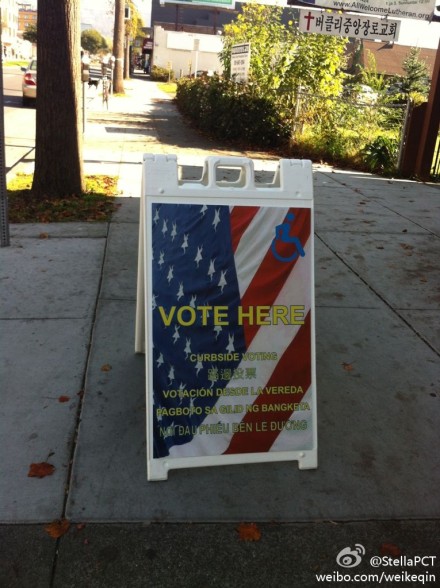 |
| @ University Ave, Berkeley CA |
Tuesday, October 30, 2012
Cultural Products
How amazing it is to see so Americans dancing to the Gangnam Style without knowing the meaning of its lyrics. It's probably not surprising to see pop stars like Britney Spears to imitate PSY, her Korean counterpart's; but now every one - politicians, scholars and artists, etc is dancing to the song and sharing the videos online. A few weeks ago, I saw a MTV called "Romney Style", later I found a similar one called "Obama style", and finally Romney did dance to the Gangnam Style in one of his campaigns, which was taken as a strategy to attract young voters. Yesterday I found a video on Youtube about PhDs and professors at MIT, and business students at Stanford dancing to Gangnam Style. It looks like you're out of fashion if you're not dancing to the Gangnam Style. Why? Because every one else is doing that.
I have no idea why this song is so popular, and I'm even more confused at why people enjoy it so much without knowing the meaning of the song. But the popularity of Gangnam Style seems to imply a potential global market for Asian cultural products in spite of the differences in languages, traditions and culture. Hollywood movies and American sitcoms already become popular with young audiences in Asia, thanks to the universal English education and values; and a few Asian movies are shown in the US too. But some ideas are hard to translate. Take a Chinese movie for example. Farewell My Concubine, the Golden Globe Awards winner in 1993, tells a story of Peking Opera actors from early 1920s to the end of Cultural Revolution. The film narrative seems prosaic in lack of climax, and a feeling of melancholy runs through the entire movie, which is in sharp contrast to the turbulent era in China and the dramatic Peking Opera. However for audience without the knowledge of Chinese history or Peking Opera, it's difficult to see this artistic expression.
To make cultural products popular in a different cultural setting, a shortcut is to keep it simple and stupid. Gangnam Style is a song mocking at rick people in Soul, but no one cares about what it says, they only like the few dancing movements and shouting "oppa gangnam style!" when doing them. Many Hollywood movies find the best way of selling their movies in overseas markets is to show fancy pictures like The Lord of the Rings, or glaring CG stunts like Transformers, not trying to explore profound themes in 2 hours. This proves to be a very wise strategy. Why is Avatar such a success? Stories are old, but people went there to enjoy an unprecedented imax 3D movie. Most audiences probably can't recall the story, but they will always remember flying with avatars on the back of that big bird. Because of the big gap in technology, it is always easy for American movies to take Asian markets, not vice verse.
But it may come to the point that people's utility curve from fancy movie technologies flat out, and their demand for something else starts to increase. Then the challenge to cultural products is how to convey ideas instead of pictures, and that will be a real headache.
I have no idea why this song is so popular, and I'm even more confused at why people enjoy it so much without knowing the meaning of the song. But the popularity of Gangnam Style seems to imply a potential global market for Asian cultural products in spite of the differences in languages, traditions and culture. Hollywood movies and American sitcoms already become popular with young audiences in Asia, thanks to the universal English education and values; and a few Asian movies are shown in the US too. But some ideas are hard to translate. Take a Chinese movie for example. Farewell My Concubine, the Golden Globe Awards winner in 1993, tells a story of Peking Opera actors from early 1920s to the end of Cultural Revolution. The film narrative seems prosaic in lack of climax, and a feeling of melancholy runs through the entire movie, which is in sharp contrast to the turbulent era in China and the dramatic Peking Opera. However for audience without the knowledge of Chinese history or Peking Opera, it's difficult to see this artistic expression.
To make cultural products popular in a different cultural setting, a shortcut is to keep it simple and stupid. Gangnam Style is a song mocking at rick people in Soul, but no one cares about what it says, they only like the few dancing movements and shouting "oppa gangnam style!" when doing them. Many Hollywood movies find the best way of selling their movies in overseas markets is to show fancy pictures like The Lord of the Rings, or glaring CG stunts like Transformers, not trying to explore profound themes in 2 hours. This proves to be a very wise strategy. Why is Avatar such a success? Stories are old, but people went there to enjoy an unprecedented imax 3D movie. Most audiences probably can't recall the story, but they will always remember flying with avatars on the back of that big bird. Because of the big gap in technology, it is always easy for American movies to take Asian markets, not vice verse.
But it may come to the point that people's utility curve from fancy movie technologies flat out, and their demand for something else starts to increase. Then the challenge to cultural products is how to convey ideas instead of pictures, and that will be a real headache.
 |
| http://goo.gl/hhfHq |
Tuesday, October 23, 2012
Gambling
I went to watch the final presidential debate with a binder full of ERGies. Gang's friend Jimmy invited us over to watch the debate on foreign policy at his place. The debate was completely off the topic, but it didn't prevent us from enjoying the debate drinking game.
The biggest gain from last night was not seeing how politicians do Taichi to each other during the debate by avoiding questions, twisting facts and changing topics, but a website mentioned by Chris. Intrade.com provides a market in which people can predict who will win the election, such as who will be elected the next president, who will lead in each swing state, and who will control the Senate/House, and therefore own money from right predictions. The price of each share changes as the campaign goes on. For example, after Obama got drowsy during his first debate, the price of share for "Obama will win" dropped from almost $8 to less than $6. His next two debates reversed the trend and pushed the price above $6 now, but never back to its peak. We found this market very interesting and tried to buy a few shares just for fun. But as we registered and logged in, we found the procedures cumbersome: we needed to scan and send over our ID cards for confirmation, and the money couldn't be paid by either credit card or debit card. Also, Intrade.com requires a monthly transaction fee of around $5.
I learned about futures markets in my financial class, and how agency make money from both sides by taking the risks of insolvency. The business is no longer new, but Intrade.com is much easier: it only focuses on policy issues, and to each question there are only two options, yes or no. For example, there is a bet on whether a cap and trade system for emissions trading to be established before midnight ET on 31 Dec 2013, and another on whether the US and/or Israel are to execute an overt air strike against Iran before midnight ET 31 Dec 2013. About a hundred market is listed on its website, from the change of global temperature, terrorist attack, income tax rates, to the time for World Trade Center's reopening, etc. Where there is uncertainty, there is a market for gambling. In comparison to guessing the change of oil price in the following months and years, it's much easier to guess "Yes" or "No". However the risk is higher: once you lose, you lose everything.
I don't think a similar business model exists in China, and one obstacle I can think of to replicating the model in China is the opaque government policy-making process. Two weeks before the US election, no one knows who will be the next US president (though I think Obama has a better chance); but two years ago we already knew who will be the next Chinese president. However only people close to the core know what happens and have more information to predict the result, but majority remains uninformed - yes we know the result, but we don't know what leads to the result. However it may be interesting to try a bet on something like whether China and Japan will fight over Diaoyu Island or when will be Liaoning Hao's first voyage.

The biggest gain from last night was not seeing how politicians do Taichi to each other during the debate by avoiding questions, twisting facts and changing topics, but a website mentioned by Chris. Intrade.com provides a market in which people can predict who will win the election, such as who will be elected the next president, who will lead in each swing state, and who will control the Senate/House, and therefore own money from right predictions. The price of each share changes as the campaign goes on. For example, after Obama got drowsy during his first debate, the price of share for "Obama will win" dropped from almost $8 to less than $6. His next two debates reversed the trend and pushed the price above $6 now, but never back to its peak. We found this market very interesting and tried to buy a few shares just for fun. But as we registered and logged in, we found the procedures cumbersome: we needed to scan and send over our ID cards for confirmation, and the money couldn't be paid by either credit card or debit card. Also, Intrade.com requires a monthly transaction fee of around $5.
I learned about futures markets in my financial class, and how agency make money from both sides by taking the risks of insolvency. The business is no longer new, but Intrade.com is much easier: it only focuses on policy issues, and to each question there are only two options, yes or no. For example, there is a bet on whether a cap and trade system for emissions trading to be established before midnight ET on 31 Dec 2013, and another on whether the US and/or Israel are to execute an overt air strike against Iran before midnight ET 31 Dec 2013. About a hundred market is listed on its website, from the change of global temperature, terrorist attack, income tax rates, to the time for World Trade Center's reopening, etc. Where there is uncertainty, there is a market for gambling. In comparison to guessing the change of oil price in the following months and years, it's much easier to guess "Yes" or "No". However the risk is higher: once you lose, you lose everything.
I don't think a similar business model exists in China, and one obstacle I can think of to replicating the model in China is the opaque government policy-making process. Two weeks before the US election, no one knows who will be the next US president (though I think Obama has a better chance); but two years ago we already knew who will be the next Chinese president. However only people close to the core know what happens and have more information to predict the result, but majority remains uninformed - yes we know the result, but we don't know what leads to the result. However it may be interesting to try a bet on something like whether China and Japan will fight over Diaoyu Island or when will be Liaoning Hao's first voyage.

Monday, October 22, 2012
English is Hard
Most Chinese students start learning English in middle school, taking 4-5 English courses per week and dealing with piles of homework and exams. After six hellish years in middle school and high school, some of them decide that they've had enough, and will never read or speak English; and some decide to continue their English studies by taking more English courses and having more assignment and exams. I'm one of the latter: English courses were compulsory for students in my school, and I took at least one English courses per semester. Some English courses were taught by native speakers, and what we did in class was basically watching TV shows or playing games; some were taught by Chinese professors, who showed great interests in tangling with jargon in political science.
My point is I had been learning English successively for ten years before coming to the US, and I still found it difficult to communicate with local people! One day I went to do laundry, and a friend of mine was in the laundry room too. She asked me if she could use my "detergent". I stood still and looked at her in confusion, holding the detergent in my hands. "Sorry, what's deter...?"
She pointed at the bottle in my hand, "Can I use this?"
"Oh of course, help yourself." I finally understood the meaning of "detergent".
Yes, don't laugh, I know what "authoritarianism" is, but I didn't know what "detergent" is.
Some English words are translated into the same Chinese word, but they do have different meanings in English. This story happened during my second year at Princeton, when my roommate Leslie and I were preparing a surprise Birthday party for Vanessa, the other roommate. Our plan was to have her husband come over from NYC and celebrated her birthday with friends at night - after our class on impact evaluation at 9pm. Leslie was running some errand in the afternoon, therefore she left the apt key under mat for Vanessa's husband, who would have access to the apt when Leslie was away. Things do not always go as they are planned. Vanessa went back to apt in the afternoon before her husband arrived, and found the mat was kicked away by someone and the key was left outside. So she asked Leslie, who happened to be with her at that time. Leslie answered calmly:" Oh it's Keqin's key." And she soon called me, saying her key under the "mat" was found by Vanessa, she claimed it to be mine, and she wanted to make sure that I wouldn't give her away. I caught the keyword "mat", but unfortunately the first thing came to my mind was the rug in the living room. I wanted to ask Leslie why she hid her key under the rug in the living room, but she hang up. Later that night, I was assigned the task of walking back to the apartment with Vanessa after the evening class, and slowing her down so that other people would have enough time to set up. I thought for a while, and found a perfect excuse (I thought). So I asked Vanessa: "I left my key in the apartment, can I go back with you?"
Vanessa looked confused: "I thought you left the key for someone under the mat."
"Yes, that's why I don't have it..." Then I realized the true "mat" that Leslie was talking about.
Vanessa looked at me in suspicious. I stood there awkwardly, having no idea of how to explain it. Later she told me she sensed the party a little bit by my mistake. And I learned the difference between mat and rug.
The other day I drove my car for smog check. After the check was done, the mechanic was typing something into his computer. I asked him if I could get a "hard copy" of the smog check report so that I could bring it over to DMV. He looked at me strangely and said: "Well, then I have to make it."
I said to myself, "this guy is so lazy, he doesn't even want to print it!" So I replied, "then can you make it?"
The mechanic paused for a few seconds, and said: "Sure... but it might take a while."
I felt he was reluctant to make the "hard copy", but I couldn't figure out why, and I didn't understand how printing a copy could "take a while". So I explained to him that I knew usually the report was sent to DMV's database directly so it wouldn't be a big problem if I didn't have to hard copy with me, but in case things went wrong, it was always better to obtain a hard copy.
"Oh!" He laughed, "I thought you wanted a 'hot coffee'!"
These are some of my wonderful memories with English. A lovely language!
My point is I had been learning English successively for ten years before coming to the US, and I still found it difficult to communicate with local people! One day I went to do laundry, and a friend of mine was in the laundry room too. She asked me if she could use my "detergent". I stood still and looked at her in confusion, holding the detergent in my hands. "Sorry, what's deter...?"
She pointed at the bottle in my hand, "Can I use this?"
"Oh of course, help yourself." I finally understood the meaning of "detergent".
Yes, don't laugh, I know what "authoritarianism" is, but I didn't know what "detergent" is.
Some English words are translated into the same Chinese word, but they do have different meanings in English. This story happened during my second year at Princeton, when my roommate Leslie and I were preparing a surprise Birthday party for Vanessa, the other roommate. Our plan was to have her husband come over from NYC and celebrated her birthday with friends at night - after our class on impact evaluation at 9pm. Leslie was running some errand in the afternoon, therefore she left the apt key under mat for Vanessa's husband, who would have access to the apt when Leslie was away. Things do not always go as they are planned. Vanessa went back to apt in the afternoon before her husband arrived, and found the mat was kicked away by someone and the key was left outside. So she asked Leslie, who happened to be with her at that time. Leslie answered calmly:" Oh it's Keqin's key." And she soon called me, saying her key under the "mat" was found by Vanessa, she claimed it to be mine, and she wanted to make sure that I wouldn't give her away. I caught the keyword "mat", but unfortunately the first thing came to my mind was the rug in the living room. I wanted to ask Leslie why she hid her key under the rug in the living room, but she hang up. Later that night, I was assigned the task of walking back to the apartment with Vanessa after the evening class, and slowing her down so that other people would have enough time to set up. I thought for a while, and found a perfect excuse (I thought). So I asked Vanessa: "I left my key in the apartment, can I go back with you?"
Vanessa looked confused: "I thought you left the key for someone under the mat."
"Yes, that's why I don't have it..." Then I realized the true "mat" that Leslie was talking about.
Vanessa looked at me in suspicious. I stood there awkwardly, having no idea of how to explain it. Later she told me she sensed the party a little bit by my mistake. And I learned the difference between mat and rug.
The other day I drove my car for smog check. After the check was done, the mechanic was typing something into his computer. I asked him if I could get a "hard copy" of the smog check report so that I could bring it over to DMV. He looked at me strangely and said: "Well, then I have to make it."
I said to myself, "this guy is so lazy, he doesn't even want to print it!" So I replied, "then can you make it?"
The mechanic paused for a few seconds, and said: "Sure... but it might take a while."
I felt he was reluctant to make the "hard copy", but I couldn't figure out why, and I didn't understand how printing a copy could "take a while". So I explained to him that I knew usually the report was sent to DMV's database directly so it wouldn't be a big problem if I didn't have to hard copy with me, but in case things went wrong, it was always better to obtain a hard copy.
"Oh!" He laughed, "I thought you wanted a 'hot coffee'!"
These are some of my wonderful memories with English. A lovely language!
Tuesday, October 16, 2012
Presidential Debate
I'm trying to type this blog from iPad, and it's working! Well, it's not convenient at all, but it's funny. I downloaded a few Apps yesterday, one of them is to turn iPad into a screen for laptops, and the other is to turn iPad into a keyboard and mouse. For sure these Apps outstand iPad and smartphones in there peers.
I joined Gang in watching the second presidential debate tonight, when Obama finally realized that he couldn't play the humble card any more but fought back. This is the first time that I watched a presidential debate from the beginning to the end, and it's always a pleasure to see politicians being challenged by each other. Romney seemed unprepared - his only focus was to attack Obama's failure on economic issues, but didn't think through other policies, such as cultural issues, gender, foreign policy, etc. Therefore when he came across questions that he lacked interests, or the ones that the Republicans couldn't stand well with, he tried to switch the topics to the parts that were attractive to conservatives, and could be twisted to against Obama. The current president was obviously more familiar with his job, and therefore was able to address questions more directly. The coordinator tried to push Romney several times to answer questions instead of mumbo-jumbo. I was thinking, poor guy, he probably thought he already answered the question.
Politicians always lie, and it's interesting to see how they labeled each other as an liar while continuing hiding or making up facts. Romney talked about his big plan which was suspiciously not feasibly due to the lack of details, while blaming Obama for failing to carry out his commitments four years ago; while Obama tried to convince the audience that he has at least partly done his job, and in spite of his poor performance Romney could do worse considering his affiliation with Republics. Though it may not be fair to put all the blames on Obama, the President did fail to reach his original target; and since no new recovery policy had been raised, it is reasonable to remain suspicious of his performance in the next term should he elected. Romney equally lacked credit due to his empty big talks. Regardless who gets elected, the economy may recover in its own way. What we don't know is who can be lucky enough to take the chair when things are getting better.
The most impressive part of the debate tonight is the audience, who asks great tough questions, which can never happen in China as long as the CCP occupies the government; and the coordinator also did a good job, who (at least tried to) control the time and urge both candidates address questions during the entire debate. But we probably should also thank both candidates for the debates, which have brought so many joys to us already. Romney has a slippery tongue as usual and now binders full of women are posted everywhere on internet, almost as popular as the Big Bird last week. These presidential candidates, as well as their media and reporters, provide us tons of jokes because of their self-contradictory speeches and behaviors; and the money that barons throw on the election also create job opportunities for those suffering in the recession.

I joined Gang in watching the second presidential debate tonight, when Obama finally realized that he couldn't play the humble card any more but fought back. This is the first time that I watched a presidential debate from the beginning to the end, and it's always a pleasure to see politicians being challenged by each other. Romney seemed unprepared - his only focus was to attack Obama's failure on economic issues, but didn't think through other policies, such as cultural issues, gender, foreign policy, etc. Therefore when he came across questions that he lacked interests, or the ones that the Republicans couldn't stand well with, he tried to switch the topics to the parts that were attractive to conservatives, and could be twisted to against Obama. The current president was obviously more familiar with his job, and therefore was able to address questions more directly. The coordinator tried to push Romney several times to answer questions instead of mumbo-jumbo. I was thinking, poor guy, he probably thought he already answered the question.
Politicians always lie, and it's interesting to see how they labeled each other as an liar while continuing hiding or making up facts. Romney talked about his big plan which was suspiciously not feasibly due to the lack of details, while blaming Obama for failing to carry out his commitments four years ago; while Obama tried to convince the audience that he has at least partly done his job, and in spite of his poor performance Romney could do worse considering his affiliation with Republics. Though it may not be fair to put all the blames on Obama, the President did fail to reach his original target; and since no new recovery policy had been raised, it is reasonable to remain suspicious of his performance in the next term should he elected. Romney equally lacked credit due to his empty big talks. Regardless who gets elected, the economy may recover in its own way. What we don't know is who can be lucky enough to take the chair when things are getting better.
The most impressive part of the debate tonight is the audience, who asks great tough questions, which can never happen in China as long as the CCP occupies the government; and the coordinator also did a good job, who (at least tried to) control the time and urge both candidates address questions during the entire debate. But we probably should also thank both candidates for the debates, which have brought so many joys to us already. Romney has a slippery tongue as usual and now binders full of women are posted everywhere on internet, almost as popular as the Big Bird last week. These presidential candidates, as well as their media and reporters, provide us tons of jokes because of their self-contradictory speeches and behaviors; and the money that barons throw on the election also create job opportunities for those suffering in the recession.

Thursday, October 11, 2012
Getaway to A New Market
There is a challenge for almost every multi-national, regardless how powerful it is, and so far no satisfying solution has been provided: how to adjust itself to an oversea market? It's no longer novel to see foreign companies adopting new corporate culture for their branches in a foreign country. Walmart, Carrefour and their western peers have to establish Communist Party Committees in their Chinese branches to meet requirements of local laws; and Google faced challenges from the government news censorship and security issues when providing search engines to its Chinese customers.
Just as western companies feel unacclimatized to Chinese markets, Chinese companies also come across troubles when trying to enter western markets. Huawei and ZTE were challenged with security concerns when they were applying for US market entry permission. I watched the hearing before the Congress on Youtube, which lasted for more than three hours and raised many interesting questions.
One question that challenged both companies was the role of Party Committee in their companies. The CCP Committee is an interesting organization in the sense that there isn't a clear definition of its role but its impact is everywhere. On the face of it, it does not interfere the operations or decision-making process of companies, but you absolutely don't want to go against it. The existence of Party Committee doesn't imply that the Party has direct control over it - almost every organization has a Party Committee; but it also doesn't mean that the company can be independent of the influence from the Party. The Party Committee system has been firmly established as a legacy from 1989, and is one of the most silly systems in China. Obviously the US Congress found it ridiculous to have a Party Committee in a company while keeping its independence and was very concerned about the components of the Committee. If I were the US Congress, I would not worry that much about this Party Committee thing, but might want to investigate further on their connection with PLA.
Another question also reflects the deep distrust of the US on Chinese companies. Huawei and ZTE were questioned if they would provide information to the Chinese government at the cost of their clients' benefits. Both companies promised not to do so. But the chairman sniffed at it and said, "even if that will put you in jail?" Even I can't buy their answers. Yahoo!, an American company, had to sell its clients' information to Chinese government to legitimize its operations in China, let alone Chinese companies: how can their US branch continue to work when the parent company gets in trouble? Not every company can be Google, and it's simply too costly for Huawei and ZTE to give up their Chinese market share.
This is my first time to watch Chinese companies receiving hearings in the US Congress, and I think this will provide a big lesson for their Chinese fellows. The difference in market and corporate-government relations between the US and China can produce huge barriers for companies on each side. Now the security concerns stopped Huawei and ZTE from expanding into the US market, and next time other issues may be raised against Chinese companies. To overcome the obstacles, fundamental internal reforms will be required to adapt Chinese companies to free markets; and the relationship between government and market in China has to be reformed as well.
Before any big change takes place, there is one thing that Chinese companies can do to assuage the conflicts between different systems: find better spokesmen. Both the hearing looked so miserable partly because of the deep-rooted difference between China and the US, but partly due to the way these two spokesmen handled the questions. Both of them, I believe, are high-level officials in the company, and they are too familiar with dealing with Chinese officials, and are very good at empty talks. However it doesn't work in the US: the Congress kept urging them to answer questions, providing details instead of talking "principles". Also, they may want to improve their English and know more about the US culture, which will help them better answer the questions as well.
Anyway, I'm proud to see Chinese companies making progress in exploring international markets. Learning by doing, and the growing pains will be beneficial in the future. This hearing will be historical.

Just as western companies feel unacclimatized to Chinese markets, Chinese companies also come across troubles when trying to enter western markets. Huawei and ZTE were challenged with security concerns when they were applying for US market entry permission. I watched the hearing before the Congress on Youtube, which lasted for more than three hours and raised many interesting questions.
One question that challenged both companies was the role of Party Committee in their companies. The CCP Committee is an interesting organization in the sense that there isn't a clear definition of its role but its impact is everywhere. On the face of it, it does not interfere the operations or decision-making process of companies, but you absolutely don't want to go against it. The existence of Party Committee doesn't imply that the Party has direct control over it - almost every organization has a Party Committee; but it also doesn't mean that the company can be independent of the influence from the Party. The Party Committee system has been firmly established as a legacy from 1989, and is one of the most silly systems in China. Obviously the US Congress found it ridiculous to have a Party Committee in a company while keeping its independence and was very concerned about the components of the Committee. If I were the US Congress, I would not worry that much about this Party Committee thing, but might want to investigate further on their connection with PLA.
Another question also reflects the deep distrust of the US on Chinese companies. Huawei and ZTE were questioned if they would provide information to the Chinese government at the cost of their clients' benefits. Both companies promised not to do so. But the chairman sniffed at it and said, "even if that will put you in jail?" Even I can't buy their answers. Yahoo!, an American company, had to sell its clients' information to Chinese government to legitimize its operations in China, let alone Chinese companies: how can their US branch continue to work when the parent company gets in trouble? Not every company can be Google, and it's simply too costly for Huawei and ZTE to give up their Chinese market share.
This is my first time to watch Chinese companies receiving hearings in the US Congress, and I think this will provide a big lesson for their Chinese fellows. The difference in market and corporate-government relations between the US and China can produce huge barriers for companies on each side. Now the security concerns stopped Huawei and ZTE from expanding into the US market, and next time other issues may be raised against Chinese companies. To overcome the obstacles, fundamental internal reforms will be required to adapt Chinese companies to free markets; and the relationship between government and market in China has to be reformed as well.
Before any big change takes place, there is one thing that Chinese companies can do to assuage the conflicts between different systems: find better spokesmen. Both the hearing looked so miserable partly because of the deep-rooted difference between China and the US, but partly due to the way these two spokesmen handled the questions. Both of them, I believe, are high-level officials in the company, and they are too familiar with dealing with Chinese officials, and are very good at empty talks. However it doesn't work in the US: the Congress kept urging them to answer questions, providing details instead of talking "principles". Also, they may want to improve their English and know more about the US culture, which will help them better answer the questions as well.
Anyway, I'm proud to see Chinese companies making progress in exploring international markets. Learning by doing, and the growing pains will be beneficial in the future. This hearing will be historical.

Monday, October 8, 2012
Columbus Day
I accidently found on my calendar that today is Columbus Day. The US has so many holidays that it's very easy to miss a few every year. And yes this is my first time to notice the Columbus Day, in memory of the arrival of Christopher Columbus in the America in 1492. Columbus actually arrived on Oct 12, but Columbus Day is set at the second Monday in October, and its date varies by years. Native Americans may not want to thank him for his "discovery", but all the immigrants here should be grateful to him - for bringing a virgin land to civilization, a rich land to modernization, and a big land for residence. Some states have parades to celebrate the Columbus Day but some don't even acknowledge it. Anyway I checked on internet but didn't find any typical food for this holiday, and obviously neither companies nor schools allow their employees or students to take a day off. So the conclusion is: it's not a popular holiday in the US.
Many holidays in the US sound very young: the Veteran's Day, Martin Luther King's Day, Memorial Day, etc. But they do remind people of milestones in the American history and respectable people in the country. So are holidays in China, though they are now a weird mixture of nostalgic traditional holidays, imported Western festivals and Communist ones. Interestingly, Chinese people tend to memorize and celebrate holidays with profound historical implications rather than the modern ones. For example, we are willing to travel thousands of miles to get back to our families during Spring Festival in spite of the expensive tickets, terribly crowded carriages and poor public security; or staying in the long line in grocery stores to buy Zongzi (a Chinese rice dumpling) for Duanwu and mooncake for Zhongqiu. We say "happy holidays" to each other on these days, and call family members even they are not around. When I was a kid, I enjoyed getting together in my big family, meeting cousins that I hadn't seen for a long time and competed with them on reciting poetry related to the holiday. By contrast, very few people take modern holidays, like National Day or Labor Day seriously. The government does hold ceremonies to celebrate modern ones like the Army's Day or Party's Day, but ordinary people seldom feel culturally connected to them. We travel in National Day holidays because we're given a 7-day vacation for it, but we celebrate traditional ones because they are true holidays. In recent days, young generation start to embrace Western holidays in China more than ever before. Valentine's Day and Christmas are the two most popular ones. Actually it's funny to think of their popularity in China, an atheistic country. But they're never listed as official holidays, but more like means to stimulate consumption and encourage businesses.
My connection to these Chinese traditional holidays was more or less cut off as we relocated to the US. I still celebrate the Spring Festival, Zhongqiu and other important Chinese holidays with Gang and Chinese fellows here, but it's so different from celebrating them in China, where everyone else is doing the same thing as we do. Meanwhile to me, the US holidays are only vacations when we can take days off and plan another road trip, but can hardly evoke my empathy. I guess it's easy to give up old knowledge and accept some universal values, but difficult to abandon culture and tradition.

Many holidays in the US sound very young: the Veteran's Day, Martin Luther King's Day, Memorial Day, etc. But they do remind people of milestones in the American history and respectable people in the country. So are holidays in China, though they are now a weird mixture of nostalgic traditional holidays, imported Western festivals and Communist ones. Interestingly, Chinese people tend to memorize and celebrate holidays with profound historical implications rather than the modern ones. For example, we are willing to travel thousands of miles to get back to our families during Spring Festival in spite of the expensive tickets, terribly crowded carriages and poor public security; or staying in the long line in grocery stores to buy Zongzi (a Chinese rice dumpling) for Duanwu and mooncake for Zhongqiu. We say "happy holidays" to each other on these days, and call family members even they are not around. When I was a kid, I enjoyed getting together in my big family, meeting cousins that I hadn't seen for a long time and competed with them on reciting poetry related to the holiday. By contrast, very few people take modern holidays, like National Day or Labor Day seriously. The government does hold ceremonies to celebrate modern ones like the Army's Day or Party's Day, but ordinary people seldom feel culturally connected to them. We travel in National Day holidays because we're given a 7-day vacation for it, but we celebrate traditional ones because they are true holidays. In recent days, young generation start to embrace Western holidays in China more than ever before. Valentine's Day and Christmas are the two most popular ones. Actually it's funny to think of their popularity in China, an atheistic country. But they're never listed as official holidays, but more like means to stimulate consumption and encourage businesses.
My connection to these Chinese traditional holidays was more or less cut off as we relocated to the US. I still celebrate the Spring Festival, Zhongqiu and other important Chinese holidays with Gang and Chinese fellows here, but it's so different from celebrating them in China, where everyone else is doing the same thing as we do. Meanwhile to me, the US holidays are only vacations when we can take days off and plan another road trip, but can hardly evoke my empathy. I guess it's easy to give up old knowledge and accept some universal values, but difficult to abandon culture and tradition.

Sunday, October 7, 2012
Parenting
I've been watching Modern Family these days, which is about three related families - how they deal with each other, and more importantly how parents deal with their children. I must say I don't feel confident about becoming a cool parent in the future after watching it. To be a cool parent, you need to understand your children, be sensitive to their emotional demands, but not too sensitive if they don't want so; you need to acquire some sports skills - football (or soccer in the US), basketball and baseball to cope with their constantly changing interests; and you probably even need to be strong enough to take crazy rides at Disneyland with them. To put in short, you have to be omnipotent as they demand, and disappear when you're not in need. What's worse, you pay for your own work.
Gang and I have been talking about pregnancy for a while, and I start to read related books. There seems to be enough problems when you're pregnant, but now I'm reminded that the worse is afterwards. After the short joyful moment of bringing a new life to the world, you start to make all sorts of efforts to raise him/her up in a healthy and happy way. I can hardly picture myself a capable mother, who can understand what infants are trying to express through their waving hands and babbles, teach them a language which is not even my mother tongue, start a conversation on sensitive topics or teach them how to dance in proms. There are simply too many skills to learn to help them grow up, which is almost like having a new growth experience for myself. I've never taken any course on how to bring up an Asian baby in the US, and I have 0-year experience in this field, I can't say I can do it.
Parents never stop worrying. When children are still infants, you worry about whether they will grow up healthily, and watch your words and behaviors to immune them from inappropriate impacts; when they're kids, you worry about whether they can do at least average in schools; when they grow up, you worry about how they deal with their peers, and if they're too close to some of them; and even when they finally get a job and start a family, your pains are not ending - it's time for them to remind you of all the peccadillo you've made during their growths. Sometimes I get frustrated because of the problems out of my control, and I can see how this kind of frustration become more frequently in the future when dealing with an infant, a kid and a teenager.
At the end of the blog, to clarify, first I'm not a control freak, second I'm not pregnant yet. I guess I'm just a little bit worried about my future baby who's gonna to be raised by two nerdy parents, both of which knowing more about Confucius than "row row row your boat."
Gang and I have been talking about pregnancy for a while, and I start to read related books. There seems to be enough problems when you're pregnant, but now I'm reminded that the worse is afterwards. After the short joyful moment of bringing a new life to the world, you start to make all sorts of efforts to raise him/her up in a healthy and happy way. I can hardly picture myself a capable mother, who can understand what infants are trying to express through their waving hands and babbles, teach them a language which is not even my mother tongue, start a conversation on sensitive topics or teach them how to dance in proms. There are simply too many skills to learn to help them grow up, which is almost like having a new growth experience for myself. I've never taken any course on how to bring up an Asian baby in the US, and I have 0-year experience in this field, I can't say I can do it.
Parents never stop worrying. When children are still infants, you worry about whether they will grow up healthily, and watch your words and behaviors to immune them from inappropriate impacts; when they're kids, you worry about whether they can do at least average in schools; when they grow up, you worry about how they deal with their peers, and if they're too close to some of them; and even when they finally get a job and start a family, your pains are not ending - it's time for them to remind you of all the peccadillo you've made during their growths. Sometimes I get frustrated because of the problems out of my control, and I can see how this kind of frustration become more frequently in the future when dealing with an infant, a kid and a teenager.
At the end of the blog, to clarify, first I'm not a control freak, second I'm not pregnant yet. I guess I'm just a little bit worried about my future baby who's gonna to be raised by two nerdy parents, both of which knowing more about Confucius than "row row row your boat."
 |
| Modern Family |
Saturday, September 22, 2012
Iphone
I went to Berkeley Eye Center for my first eye exam in the US. It took me two and a half hours to finish and eye exam, chose frame and lenses for my new glasses. I must admit I didn't expect it would take so long before I went there, otherwise I would have eaten some snacks before going. Later the doctor dripped a few eye-drops which helped her better check my eyes, but made myself unable to see things clearly for hours. After a two-year graduation school, my eyes are getting weaker, and my glasses are getting stronger. I finally ordered a new pair of glasses in an optical store nearby, which is expected to be ready in two weeks. The new glasses are still expensive after insurance, but I guess it's probably the cheapest I can get in the US.
OK, that's just a few nagging. What I really want to say is: "Apple Map, you suck!" I totally lost my way to the eye center following the ios6 map on my iphone: it simply gave me a wrong location! Then I needed to open Google Map through Chrome and located the eye center there. This time, it was right. But I didn't know how to find "route" on Chrome, so I had to memorize the location on Google Map and dropped a pin at a similar location on Apple Map so that I could find the "route from my current location to destination". I finally made my way to the eye center, after walking under the hot Californian sunshine for an hour. Oh iphone, you're embarrassing yourself. I wouldn't even update my ios had I knew how terrible the Apple Map is. Now I only wish Google Map can be found in App Store soon.
When I went back, my flatmate happily showed me his newly arrived iphone5. And he's been talking to siri all night, looking for nearby restaurants and UPS. His friend, who ordered iphone on the same day with him and waited at home for its delivery for the whole day, unfortunately missed the delivery because the mailman knocked at the wrong door. She didn't wait for a second delivery, but rented a car to fetch iphone5 from UPS. Later tonight my flatmate shared some tricks on playing ipad, such as flipping apps with four fingers and closing apps with five. I again found Apple a great company and iphone/ipad epoch-making products. In contrast, its outrageous replacement of Google Map is not that intolerable as well.

OK, that's just a few nagging. What I really want to say is: "Apple Map, you suck!" I totally lost my way to the eye center following the ios6 map on my iphone: it simply gave me a wrong location! Then I needed to open Google Map through Chrome and located the eye center there. This time, it was right. But I didn't know how to find "route" on Chrome, so I had to memorize the location on Google Map and dropped a pin at a similar location on Apple Map so that I could find the "route from my current location to destination". I finally made my way to the eye center, after walking under the hot Californian sunshine for an hour. Oh iphone, you're embarrassing yourself. I wouldn't even update my ios had I knew how terrible the Apple Map is. Now I only wish Google Map can be found in App Store soon.
When I went back, my flatmate happily showed me his newly arrived iphone5. And he's been talking to siri all night, looking for nearby restaurants and UPS. His friend, who ordered iphone on the same day with him and waited at home for its delivery for the whole day, unfortunately missed the delivery because the mailman knocked at the wrong door. She didn't wait for a second delivery, but rented a car to fetch iphone5 from UPS. Later tonight my flatmate shared some tricks on playing ipad, such as flipping apps with four fingers and closing apps with five. I again found Apple a great company and iphone/ipad epoch-making products. In contrast, its outrageous replacement of Google Map is not that intolerable as well.

Wednesday, September 19, 2012
Self-selection
Complaints seem to be working: after I finished my blog on broken mailbox, it got fixed an hour later with all the magazines and letters delivered as well. So I spent almost the entire day reading latest Economist episodes, trying to catch up with what's going on in the world. Since I've missed a few periodicals I decided not to read from cover to cover but to select a few articles that best interested me from each issue.
Hours have passed since I started, and I decided to review what I've read so far. Surprisingly, I found myself read most articles in the sections of US, Asia, China and International, a few from Europe, Africa, Business and Economics, but skipped most debates on America, Middle East and Science. (Actually given what's happening in Libya right now, I shouldn't spend more time on the Middle East part.) I read the Economist to broad my understanding of the world, but it looks like I automatically skip the "less interesting" ones and focus on what I'm already familiar with.
We discussed "self-selection" in the class. We self-select ourselves to the group consisting of people similar to us; and make friends with those sharing similar ideas and interests. Though I understand the importance of hearing different ideas and discussing different topics, but it's so hard to continue a conversation when you find it's impossible to get excited at some chemical solvents or biological evolution. Besides making friends, we also select to read what we agree with and get reaffirmed by reading them. I'm not a leftist, so I always make fun of the Global Times, a radical Chinese newspaper on international relations; I'm sympathetic with Democrats, so I find the Fox News a big liar although it probably doesn't lie all the time. It's true that the same issue can be explained in different ways, but once you take a position, it's really hard to accept counter arguments.
Self-selection can induce biases. People working on randomized control trials will give you a very detailed explanation on this. But to put it simple, self-selection makes these groups different from each other. This is probably why Democrats and Republicans both find their rivalries idiots and liars. Even if you take no position at the beginning, I'm sure you will hate one of them if you stay with members of the other party for too long. Mutual understanding is much easier said than done. When a compromising solution looks unfeasible (e.g. we can't have both Romney and Obama as the next US presidents), things will get even messier. Since there is no common base for both parties to discuss their policies but endless and somehow meaningless attacks and insults, let's just wait and see how much money they can squander and how many media men will become millionaires after November.
I always keep telling myself that I must make my own judgement, and do not follow the mass. But once I feel determined about something, I can't help doubt if I've missed some clues during the decision making. It's funny that once we've developed some ideas through independent thinking, we are about to lose that independent mind by self-selection to people of our own kind.
Hours have passed since I started, and I decided to review what I've read so far. Surprisingly, I found myself read most articles in the sections of US, Asia, China and International, a few from Europe, Africa, Business and Economics, but skipped most debates on America, Middle East and Science. (Actually given what's happening in Libya right now, I shouldn't spend more time on the Middle East part.) I read the Economist to broad my understanding of the world, but it looks like I automatically skip the "less interesting" ones and focus on what I'm already familiar with.
We discussed "self-selection" in the class. We self-select ourselves to the group consisting of people similar to us; and make friends with those sharing similar ideas and interests. Though I understand the importance of hearing different ideas and discussing different topics, but it's so hard to continue a conversation when you find it's impossible to get excited at some chemical solvents or biological evolution. Besides making friends, we also select to read what we agree with and get reaffirmed by reading them. I'm not a leftist, so I always make fun of the Global Times, a radical Chinese newspaper on international relations; I'm sympathetic with Democrats, so I find the Fox News a big liar although it probably doesn't lie all the time. It's true that the same issue can be explained in different ways, but once you take a position, it's really hard to accept counter arguments.
Self-selection can induce biases. People working on randomized control trials will give you a very detailed explanation on this. But to put it simple, self-selection makes these groups different from each other. This is probably why Democrats and Republicans both find their rivalries idiots and liars. Even if you take no position at the beginning, I'm sure you will hate one of them if you stay with members of the other party for too long. Mutual understanding is much easier said than done. When a compromising solution looks unfeasible (e.g. we can't have both Romney and Obama as the next US presidents), things will get even messier. Since there is no common base for both parties to discuss their policies but endless and somehow meaningless attacks and insults, let's just wait and see how much money they can squander and how many media men will become millionaires after November.
I always keep telling myself that I must make my own judgement, and do not follow the mass. But once I feel determined about something, I can't help doubt if I've missed some clues during the decision making. It's funny that once we've developed some ideas through independent thinking, we are about to lose that independent mind by self-selection to people of our own kind.
Tuesday, September 18, 2012
Broken Mailbox
The mailbox in my apartment has been broken for more than a week. I can't get my journals, cards or letters, and feel cut off from the world somehow. It again proves that even in the internet age, we still can't live without postal service.
An old poem says, "A letter from home is worth ten thousand pieces of gold." (家书抵万金) In old days, mails were delivered by mailmen on horseback. Therefore during wartime, it was extremely difficult to keep the postal service running. When family members were separated by war, the only way to find their whereabouts was to sending letters to hometown in hope of receiving responses. Thousands of years have passed, letters still remained the most important way of long-distance communication until telephone was invented. Telephone makes communication easier and faster, but fail to keep records of messages, and therefore unable to convey important messages. For example, you may write a love letter to woo the girl you've crush on, but you won't call her and say "please be my girlfriend". Telephone is not a good substitute for letters, but internet is much more similar. Emails, as we can tell by the name, are a new form of mails, but faster and cheaper. The rise of internet gives postal service the last fatal strike. Nowadays, most of what we can get from mailbox are commercial ads, government notices and bills. Personal letters largely go by emails.
Now we won't pay gold to receive a mail, and a shabby mailing system won't really undermine information communication any more, but a broken mailbox more or less prevents me from receiving important stuff. Of course I can write another blog about how terrible it is to have the mailing market twisted by the government, and make the postal service one of my worst experiences in the US (better than medical system though). But now I just want to say, I want to read my periodicals!

An old poem says, "A letter from home is worth ten thousand pieces of gold." (家书抵万金) In old days, mails were delivered by mailmen on horseback. Therefore during wartime, it was extremely difficult to keep the postal service running. When family members were separated by war, the only way to find their whereabouts was to sending letters to hometown in hope of receiving responses. Thousands of years have passed, letters still remained the most important way of long-distance communication until telephone was invented. Telephone makes communication easier and faster, but fail to keep records of messages, and therefore unable to convey important messages. For example, you may write a love letter to woo the girl you've crush on, but you won't call her and say "please be my girlfriend". Telephone is not a good substitute for letters, but internet is much more similar. Emails, as we can tell by the name, are a new form of mails, but faster and cheaper. The rise of internet gives postal service the last fatal strike. Nowadays, most of what we can get from mailbox are commercial ads, government notices and bills. Personal letters largely go by emails.
Now we won't pay gold to receive a mail, and a shabby mailing system won't really undermine information communication any more, but a broken mailbox more or less prevents me from receiving important stuff. Of course I can write another blog about how terrible it is to have the mailing market twisted by the government, and make the postal service one of my worst experiences in the US (better than medical system though). But now I just want to say, I want to read my periodicals!

Monday, September 17, 2012
They Changed the Coding
After a three-week fight against the hospital and my insurance company, they finally agreed to change the code, which hopefully will reduce my $700 medical bill mentioned in older blogs. I think I gained some experiences on getting things done in the United States.
On receiving the bill, mad as I was, I remained polite and patient when explaining why I didn't agree with the bill to my insurance company. The lady seemed to understand and agree with what I said, and promised to review it. I waited for about two weeks but nothing happened - no call, no email, even no new notice. So I called back, and was told that they couldn't do anything about it unless I called the hospital and changed the coding. OK, then I called the hospital. The hospital has several offices - dispute office, billing office, coding office and the doctor's office, but it looks like none of them takes responsibilities of serving customers. What's worse, they don't talk to each other! Anyway, I called the billing office, and was transferred to another, and transferred back again, explaining my case to every office. Finally someone seemed to be able to talk to her colleagues and told me she would file a claim for re-coding.
Another week passed, and I received a phone call from the hospital, saying sorry we can't do anything about the coding. Then I asked her about the feedback from the billing office - why my claim was disproved? The young lady sounded very confused and asked me "what claim"? So again, I repeated everything. A few days later, she called me back, saying they couldn't change the coding; but again she couldn't explain why my claim was disproved. That was when I reached my limit. A month has passed, but these people were not even looking into the case! So I told her that the whole issue is a big disappointment, and I'd prefer to speak to her manager. I hang up the phone without saying goodbye. Today I heard from her again that they changed the coding and sent the new code to my insurance company.
I was taught to be nice as I grew up. Be friendly with other people and they will treat you in the same way. But it is not the case in this society. When I patiently explained to one after the other about my case for hours, no one took it seriously. The insurance company was not interested in reviewing the claim, and the coding office was reluctant to communicate with the doctor office to check the record, both of them simply told me "it's not working" without any explanation. But when I was rude, impolitely shouting at the poor operator, problems got solved very quickly. We shouldn't blame Wall Street for what they did to the country, as it looks like the society applauds bullies but can't stand good men.
On receiving the bill, mad as I was, I remained polite and patient when explaining why I didn't agree with the bill to my insurance company. The lady seemed to understand and agree with what I said, and promised to review it. I waited for about two weeks but nothing happened - no call, no email, even no new notice. So I called back, and was told that they couldn't do anything about it unless I called the hospital and changed the coding. OK, then I called the hospital. The hospital has several offices - dispute office, billing office, coding office and the doctor's office, but it looks like none of them takes responsibilities of serving customers. What's worse, they don't talk to each other! Anyway, I called the billing office, and was transferred to another, and transferred back again, explaining my case to every office. Finally someone seemed to be able to talk to her colleagues and told me she would file a claim for re-coding.
Another week passed, and I received a phone call from the hospital, saying sorry we can't do anything about the coding. Then I asked her about the feedback from the billing office - why my claim was disproved? The young lady sounded very confused and asked me "what claim"? So again, I repeated everything. A few days later, she called me back, saying they couldn't change the coding; but again she couldn't explain why my claim was disproved. That was when I reached my limit. A month has passed, but these people were not even looking into the case! So I told her that the whole issue is a big disappointment, and I'd prefer to speak to her manager. I hang up the phone without saying goodbye. Today I heard from her again that they changed the coding and sent the new code to my insurance company.
I was taught to be nice as I grew up. Be friendly with other people and they will treat you in the same way. But it is not the case in this society. When I patiently explained to one after the other about my case for hours, no one took it seriously. The insurance company was not interested in reviewing the claim, and the coding office was reluctant to communicate with the doctor office to check the record, both of them simply told me "it's not working" without any explanation. But when I was rude, impolitely shouting at the poor operator, problems got solved very quickly. We shouldn't blame Wall Street for what they did to the country, as it looks like the society applauds bullies but can't stand good men.
Thursday, September 13, 2012
Overseas
My first visit to Japan was in summer 2005. I applied for a two-month summer program at Kyushu University in Fukuoka and spent the whole summer there. Known to those studying Sino-Japan relationship, the anti-Japanese demonstration in April that year cast a long shadow on the diplomatic ties between these two countries. I could still sense the tension during my visit. My tutor, a law student in Kyudai is a very lovely girl, and we carefully avoided talking too much about politics; and so was my host family, who greeted me warmly. But several professors did point out that due to the increasingly intense relationship between China and Japan, it's more and more difficult for Chinese people to lead normal lives in Japan: local people are reluctant to rent apartments to them; companies don't want to recruit them and even bullies prefer to rob Chinese.
When I was back to Beijing at the end of the summer, I met my Japanese friend in Peking University. He had been learning Chinese in PKU for two years, and was traveling all around China in the summer. When I asked him about his traveling, he didn't seem very happy. "People call me 'Japanese devil' when they found out I'm not Chinese," he said, "they thought I didn't understand what they were talking, but I did!" Then I asked him how he responded to the insults, he said: "I have no choice but to tolerate(忍耐)." The I shared my experiences in Fukuoka, and we both deplored the poor relationship and hatred between two countries for quite a while.
For whatever reason, when a country fails to handle its diplomacy well, its citizens overseas are always the first to be affected. Many Chinese people in the US can't help wonder which side they should take if the US and China are at war. I met a gentleman from Taiwan who migrated to the US in 1960s and have been living here ever since. His family members have all become US citizens but he still keeps his original nationality. And when I asked him why, he said he wasn't sure if he'd be loyal to the US if two countries are at war. It occurs to me very unlikely that the US will be fighting against China in the near future; but when two countries - one is your motherland and the other is your living place - have trouble with each other, the overseas will be suffering deeply inside.
The US is a diversified and individualist country, and therefore quite tolerant with immigrants. By "tolerant", I mean respecting different culture and religion, and able to detach individuals from their nationalities. But in a highly-unified nation-state, e.g. those with one ethnicity, one religion and one cultural tradition, people may view migrants very differently. Native people tend to label foreigners with their home countries first, and the migrants' ethnicity and cultural background may become their main characteristics as individuals. Things can get disastrous when migrants' home countries get into trouble with this kind of nations. As the reputation of overseas' home country is destroyed when in conflict with their resident country, the reputation of overseas are destroyed as well. They are not only suffering psychologically, but facing the threats of xenophobia. Think of the massacre of Chinese overseas in Indonesia and Philippine years ago, what did they do wrong? To the mobs, they were "wrong" only because they were Chinese.
When I was in China, surrounded by other Chinese people, I didn't have direct feeling towards how deterioration of foreign relations could affect my everyday life. But now as my family becomes more international than before, I can't be immune to the results of those stupid politicians messing up diplomatic relations. I just want to tell the high-level government position occupiers: if you can't do good, at least stop doing evil.

When I was back to Beijing at the end of the summer, I met my Japanese friend in Peking University. He had been learning Chinese in PKU for two years, and was traveling all around China in the summer. When I asked him about his traveling, he didn't seem very happy. "People call me 'Japanese devil' when they found out I'm not Chinese," he said, "they thought I didn't understand what they were talking, but I did!" Then I asked him how he responded to the insults, he said: "I have no choice but to tolerate(忍耐)." The I shared my experiences in Fukuoka, and we both deplored the poor relationship and hatred between two countries for quite a while.
For whatever reason, when a country fails to handle its diplomacy well, its citizens overseas are always the first to be affected. Many Chinese people in the US can't help wonder which side they should take if the US and China are at war. I met a gentleman from Taiwan who migrated to the US in 1960s and have been living here ever since. His family members have all become US citizens but he still keeps his original nationality. And when I asked him why, he said he wasn't sure if he'd be loyal to the US if two countries are at war. It occurs to me very unlikely that the US will be fighting against China in the near future; but when two countries - one is your motherland and the other is your living place - have trouble with each other, the overseas will be suffering deeply inside.
The US is a diversified and individualist country, and therefore quite tolerant with immigrants. By "tolerant", I mean respecting different culture and religion, and able to detach individuals from their nationalities. But in a highly-unified nation-state, e.g. those with one ethnicity, one religion and one cultural tradition, people may view migrants very differently. Native people tend to label foreigners with their home countries first, and the migrants' ethnicity and cultural background may become their main characteristics as individuals. Things can get disastrous when migrants' home countries get into trouble with this kind of nations. As the reputation of overseas' home country is destroyed when in conflict with their resident country, the reputation of overseas are destroyed as well. They are not only suffering psychologically, but facing the threats of xenophobia. Think of the massacre of Chinese overseas in Indonesia and Philippine years ago, what did they do wrong? To the mobs, they were "wrong" only because they were Chinese.
When I was in China, surrounded by other Chinese people, I didn't have direct feeling towards how deterioration of foreign relations could affect my everyday life. But now as my family becomes more international than before, I can't be immune to the results of those stupid politicians messing up diplomatic relations. I just want to tell the high-level government position occupiers: if you can't do good, at least stop doing evil.

Friday, September 7, 2012
Made by American Bees
We bought a can of honey last month at Costco. It was about twice the price of other honey packed in the same size. We ate it with waffle and bread, but didn't find out what made it more expensive than its peers until a few days ago when Gang and I were having breakfast and found a line on the package, saying "made by American bees."
These four words double the price. The majority applaud globalization and benefit more or less from the international market, there is still much to be proud of by consuming local goods, or "organic" as called in some overpriced supermarkets. Some consumers are willing to pay more because they believe local food produces less carbon footprint, which frees them from the guilt of warming the earth; some are paying more because they hope the extra payment will go to local workers and help retain jobs (even for bees) within the border; and some may just find it more comfortable to consume local food because they "know local better", therefore the quality is more reliable. For whatever reason, it works well to put "made in the US" on merchandises for a better price and sale.
In old days people paid high price for imports due to their scarcity: tea, silk and china from the Far East for example. After months of travelings on the sea, the prices of these luxuries were so high that only aristocrats could afford them and took the consumption of foreign goods as status symbols. Now the situation is reversed. People in China go after Western goods crazily, partly due to the unreliable quality of "made in China"s, partly to boast modern lifestyles characterized foreign products. Local goods seem to be ordinary and non-fancy, provided to mediocre people only.
But in the wave of globalization, as the cost of transportation continues decreasing, products from all over the world compete in a open market on a relatively equal base, with the superior selected and the inferior eliminated. Consumers' choice seem to be the best indicator of the competition: who produces the best and cheapest goods win. Industries start to concentrate in a few countries, who are substantially advantaged in intelligence, R&D, human costs or natural resources. Those who fail to stand out are always driven out of the market in the end. These make perfect sense in economic models, as the invisible hand allocates resources effectively and everyone is supposed to gain, after a fair amount of trade winners' gains go to those who lose both their markets and industry in globalization. But such compensation has never been carried out. Workers in comparative disadvantaged industries lose their jobs in the international competition but very few of them are taken care of by the government, or more specifically, by the extra taxes paid by comparative advantaged industries. For the government, the gains and losses may cancel out, and in most countries they gain much more than losses, which in turn can't produce strong motivations for them to change the status quo.
People do have sympathy for their neighbors, who are diligent and nice, but unfortunately lose jobs in competition. So the more you spend on local/domestic goods, the more you are helping your countrymen (or country bees), and the better you feel. I guess these emotions can't be modeled by economists. And now we have better reasons for eating local food: carbon footprint! Though it will be interesting if someone can calculate the how much can be saved by buying "international goods" and how much carbon emission can be reduced by investing the saving on new techs and researches.

These four words double the price. The majority applaud globalization and benefit more or less from the international market, there is still much to be proud of by consuming local goods, or "organic" as called in some overpriced supermarkets. Some consumers are willing to pay more because they believe local food produces less carbon footprint, which frees them from the guilt of warming the earth; some are paying more because they hope the extra payment will go to local workers and help retain jobs (even for bees) within the border; and some may just find it more comfortable to consume local food because they "know local better", therefore the quality is more reliable. For whatever reason, it works well to put "made in the US" on merchandises for a better price and sale.
In old days people paid high price for imports due to their scarcity: tea, silk and china from the Far East for example. After months of travelings on the sea, the prices of these luxuries were so high that only aristocrats could afford them and took the consumption of foreign goods as status symbols. Now the situation is reversed. People in China go after Western goods crazily, partly due to the unreliable quality of "made in China"s, partly to boast modern lifestyles characterized foreign products. Local goods seem to be ordinary and non-fancy, provided to mediocre people only.
But in the wave of globalization, as the cost of transportation continues decreasing, products from all over the world compete in a open market on a relatively equal base, with the superior selected and the inferior eliminated. Consumers' choice seem to be the best indicator of the competition: who produces the best and cheapest goods win. Industries start to concentrate in a few countries, who are substantially advantaged in intelligence, R&D, human costs or natural resources. Those who fail to stand out are always driven out of the market in the end. These make perfect sense in economic models, as the invisible hand allocates resources effectively and everyone is supposed to gain, after a fair amount of trade winners' gains go to those who lose both their markets and industry in globalization. But such compensation has never been carried out. Workers in comparative disadvantaged industries lose their jobs in the international competition but very few of them are taken care of by the government, or more specifically, by the extra taxes paid by comparative advantaged industries. For the government, the gains and losses may cancel out, and in most countries they gain much more than losses, which in turn can't produce strong motivations for them to change the status quo.
People do have sympathy for their neighbors, who are diligent and nice, but unfortunately lose jobs in competition. So the more you spend on local/domestic goods, the more you are helping your countrymen (or country bees), and the better you feel. I guess these emotions can't be modeled by economists. And now we have better reasons for eating local food: carbon footprint! Though it will be interesting if someone can calculate the how much can be saved by buying "international goods" and how much carbon emission can be reduced by investing the saving on new techs and researches.

Monday, August 6, 2012
The Bigger, the Better
Again I failed to resist the temptation of cheesecake and bought a 12-inch one from Costco (I told myself I need some calcium from the cheese.) The first piece did give me high utility, but it soon started to decline since the second one. Looking the rest 14 pieces, I don't know how long it will take me to finish all.
I was warned to order "half size" when dining in the US, which proves to be one of the most useful advice I've received. I don't know whether it's because people here really need that much food, or they simply like big plates and food chunks, restaurants are very generous in feeding you. Every time I have dinner outside, I do try to order "a full set" of appetizer, entree and dessert, but always give up after looking around, seeing how other customers fight against a mountain of food. If an adult only need 2,000 calories per day, they probably only need one dinner to meet the demand. In the end, I always end up with entree only, though fascinated by the inviting descriptions of appetizers and desserts.
The biggest surprise came from Texas. I once transferred in Austin with Gang. It was lunch time, and our flight was not leaving until two hours later, so we decided to grab a quick lunch. I bought two burgers, both of which were about three times the size of McDonald burgers (which by the way is pretty big already.) I brought burgers to Gang, looking as if I was carrying two bricks. We finished less than half of our burgers, and had to throw the rest away.
Businessmen here seem to embrace the idea of "the bigger the better." Bigger packages imply abundance, and no worriment about shortage. When items are sold in big size, the average cost per unit is reduced and customers may mistake it as a good deal. But lured by a deal like this may result in uneconomic decisions:
One concern is the wasting. (Think hard about famine victims in Africa when we talk about this point.) Food go bad if you can't finish them in time, power storage declines if batteries have passed expiration, and clothes can be out of fashion if staying closet for too long. We are sometimes too confident in our consumption capabilities.
The other concern is the negative externality on consumption of other items. For consumers, utility is reduced by the constraint on minimum consumption of each good. Because of the big size of entree, I can't diverse my consumption by including appetizers and desserts. According to economic theories, my utility is not maximized. Economists are always wrong, but this times they are right. For suppliers, they do not de facto sell more by offering larger packages because of the substitution effect. People consume more A at the cost of consuming less B. So if you think of total consumption of different goods, it's hard to tell whether merchants are able to increase sales or not.
Some people are good at consuming and successfully finish everything they have bought. That partly explains why the adult obesity rate increases to 35.7% in 2012 (Source: Centers for Disease Control and Prevention), which is expected to continue rising over and reach 42% in 3020 (Source: fox news). Similarly the energy consumption per capita in the US also ranks No.7 in the world (Source: World Bank) for bigger houses and autos. Encouraged by merchants, people are justified to consume more than needed.
To rescue consumers from the guilt of over consumption, merchants have to further enlarge everything else to match up increasing sizes. One example is the change in clothes size. Banana republic renamed its size 0 with a new size of 00, thus consumers will feel better when they find themselves still able to fit in pants with the same size in spite of overeating. Of course the best solution is to change the definition of "obesity": by raising the threshold, we will find a reduction in obese population for sure.
We probably should be jealous of a country which can squander resources in such a common way. But when the world is facing scarcity, and current consumption level is inconducive to better lives, it is time to rethink of this business tradition.

I was warned to order "half size" when dining in the US, which proves to be one of the most useful advice I've received. I don't know whether it's because people here really need that much food, or they simply like big plates and food chunks, restaurants are very generous in feeding you. Every time I have dinner outside, I do try to order "a full set" of appetizer, entree and dessert, but always give up after looking around, seeing how other customers fight against a mountain of food. If an adult only need 2,000 calories per day, they probably only need one dinner to meet the demand. In the end, I always end up with entree only, though fascinated by the inviting descriptions of appetizers and desserts.
The biggest surprise came from Texas. I once transferred in Austin with Gang. It was lunch time, and our flight was not leaving until two hours later, so we decided to grab a quick lunch. I bought two burgers, both of which were about three times the size of McDonald burgers (which by the way is pretty big already.) I brought burgers to Gang, looking as if I was carrying two bricks. We finished less than half of our burgers, and had to throw the rest away.
Businessmen here seem to embrace the idea of "the bigger the better." Bigger packages imply abundance, and no worriment about shortage. When items are sold in big size, the average cost per unit is reduced and customers may mistake it as a good deal. But lured by a deal like this may result in uneconomic decisions:
One concern is the wasting. (Think hard about famine victims in Africa when we talk about this point.) Food go bad if you can't finish them in time, power storage declines if batteries have passed expiration, and clothes can be out of fashion if staying closet for too long. We are sometimes too confident in our consumption capabilities.
The other concern is the negative externality on consumption of other items. For consumers, utility is reduced by the constraint on minimum consumption of each good. Because of the big size of entree, I can't diverse my consumption by including appetizers and desserts. According to economic theories, my utility is not maximized. Economists are always wrong, but this times they are right. For suppliers, they do not de facto sell more by offering larger packages because of the substitution effect. People consume more A at the cost of consuming less B. So if you think of total consumption of different goods, it's hard to tell whether merchants are able to increase sales or not.
Some people are good at consuming and successfully finish everything they have bought. That partly explains why the adult obesity rate increases to 35.7% in 2012 (Source: Centers for Disease Control and Prevention), which is expected to continue rising over and reach 42% in 3020 (Source: fox news). Similarly the energy consumption per capita in the US also ranks No.7 in the world (Source: World Bank) for bigger houses and autos. Encouraged by merchants, people are justified to consume more than needed.
To rescue consumers from the guilt of over consumption, merchants have to further enlarge everything else to match up increasing sizes. One example is the change in clothes size. Banana republic renamed its size 0 with a new size of 00, thus consumers will feel better when they find themselves still able to fit in pants with the same size in spite of overeating. Of course the best solution is to change the definition of "obesity": by raising the threshold, we will find a reduction in obese population for sure.
We probably should be jealous of a country which can squander resources in such a common way. But when the world is facing scarcity, and current consumption level is inconducive to better lives, it is time to rethink of this business tradition.

Friday, August 3, 2012
Tolerance for Diversity
I went to see my OB at Berkeley yesterday. I'm a new patient to her, so she asked me a few routine questions before check-up.
"Are you sexually active?" She asked.
This is really straightforward. I thought to myself. When I was in Beijing, the MD there asked me "are you married?" to get the same information.
Her next question was even more unexpected. "Is your partner male or female?"
This is not a difficult question, but I've never been asked about this before. In China, we take it for granted that guys' partners are "wives", and women's are husbands. No one considers this improper. Gay couples don't correct mistakes like this either because it may trigger an endless debate over value judgement.
I remember about two weeks after my arrival in Princeton, I had a coffee with a friend from the same program after a long group discussion at night. We hardly knew each other at that time, so we asked about working experiences, research interests, family members, and then personal lives.
"Wow, so you are married!" He looked really surprised, "it must be tough to be so far away from your husband."
"I know! It is difficult. Thank god it's only two years." I forced a smile.
Then there was short silence. I felt like I should ask about him in return. "So, how about you? Do you have a girlfriend?"
He paused for a while, "no, I don't."
"Being single is cool, you have full control of your life."
"Actually," he said with a shy smile on his face, "I have a boyfriend."
The next five minutes were filled with my apologies. I suddenly realized that I had just committed a mistake which could be very offensive to some people. Later I noticed that my new classmates always asked about my "partner", instead of more specific terms like husband or boyfriend when we first talked about personal lives.
It is the details like this revealing how minorities are dramatically underrepresented in a unanimous society. Heterosexual chauvinism excludes gay groups from expressing their pride, nor using more inclusive language to describe their lives. Not only on sexual orientation, unanimous societies have uniform standards for almost every field. Students are supposed to study hard, get high grade in exams and go to good universities; workers have to work hard and follow the instructions from the above. Young people should get married before turning 30 with an apartment and a stable job, with a baby born in 3 years. If you are off the track, you are in trouble. Well, not only you, your parents will be suffering from social pressures as well.
Sometimes people can "correct" themselves to meet the standards, sometimes not. For the latter, it is painful to live under disguise. If you very unfortunately are one of the minorities in this society, the best way to protect yourself is to hide your uniqueness and act as majority. A documentary recorded the lives of "Tongqi" (gay's wife) in China. It's reckoned that about 1.6 million women are married to gay without knowing the true sexual orientation of their spouses, and their husbands choose to marry women only out of pressure from family and society. Families like this always end in tragedy as wives doubt their attractiveness while husbands cannot stay with their true love.
Everyone is born unique. But some people take it for granted that everyone else in the world should be the same as him/her otherwise there must be something "wrong". And even worse, they may want to correct the "wrongness". Conformité, que de crimes on commet en ton nom!

"Are you sexually active?" She asked.
This is really straightforward. I thought to myself. When I was in Beijing, the MD there asked me "are you married?" to get the same information.
Her next question was even more unexpected. "Is your partner male or female?"
This is not a difficult question, but I've never been asked about this before. In China, we take it for granted that guys' partners are "wives", and women's are husbands. No one considers this improper. Gay couples don't correct mistakes like this either because it may trigger an endless debate over value judgement.
I remember about two weeks after my arrival in Princeton, I had a coffee with a friend from the same program after a long group discussion at night. We hardly knew each other at that time, so we asked about working experiences, research interests, family members, and then personal lives.
"Wow, so you are married!" He looked really surprised, "it must be tough to be so far away from your husband."
"I know! It is difficult. Thank god it's only two years." I forced a smile.
Then there was short silence. I felt like I should ask about him in return. "So, how about you? Do you have a girlfriend?"
He paused for a while, "no, I don't."
"Being single is cool, you have full control of your life."
"Actually," he said with a shy smile on his face, "I have a boyfriend."
The next five minutes were filled with my apologies. I suddenly realized that I had just committed a mistake which could be very offensive to some people. Later I noticed that my new classmates always asked about my "partner", instead of more specific terms like husband or boyfriend when we first talked about personal lives.
It is the details like this revealing how minorities are dramatically underrepresented in a unanimous society. Heterosexual chauvinism excludes gay groups from expressing their pride, nor using more inclusive language to describe their lives. Not only on sexual orientation, unanimous societies have uniform standards for almost every field. Students are supposed to study hard, get high grade in exams and go to good universities; workers have to work hard and follow the instructions from the above. Young people should get married before turning 30 with an apartment and a stable job, with a baby born in 3 years. If you are off the track, you are in trouble. Well, not only you, your parents will be suffering from social pressures as well.
Sometimes people can "correct" themselves to meet the standards, sometimes not. For the latter, it is painful to live under disguise. If you very unfortunately are one of the minorities in this society, the best way to protect yourself is to hide your uniqueness and act as majority. A documentary recorded the lives of "Tongqi" (gay's wife) in China. It's reckoned that about 1.6 million women are married to gay without knowing the true sexual orientation of their spouses, and their husbands choose to marry women only out of pressure from family and society. Families like this always end in tragedy as wives doubt their attractiveness while husbands cannot stay with their true love.
Everyone is born unique. But some people take it for granted that everyone else in the world should be the same as him/her otherwise there must be something "wrong". And even worse, they may want to correct the "wrongness". Conformité, que de crimes on commet en ton nom!

Subscribe to:
Posts (Atom)