As a person who's never tried weed before, I don't really understand why the legalization of mariguana in Colorado can be such an excitement to some of my friends. Not only that, the pleasance of enjoying mariguana in the public produces some negative externalities - the smell of weed on Berkeley streets are driving me crazy. I took a walk this afternoon in downtown for fresh air. Beautiful sunshine lightened up the world, when I suddenly came across strong stink at the corner. I trotted a few steps, but the smell made me sick for quite a while. This is not the first time I've smelled weed in Berkeley, the smell is almost everywhere - in downtown, in parks, by stations. What I don't understand is, in a country where public smoking is strictly forbidden, drugs are not treated in the same way.
Freedom has been widely discussed in modern society: the freedom to speak, the freedom to talk back, and the freedom to escalate the quarrel. Sometimes to protect other people's freedom, the government has to put certain limitations on our freedom. For example, to protect people's freedom of accessing public roads, there are traffic rules to guarantee rational use of infrastructure, the broken of which are subject to punishment. This is straightforward, but more controversial cases arise when freedoms are in conflict. Now to protect people's freedom of "getting high", I have to sacrifice my freedom of enjoying clean air. So the question is where is the line?
In a culture where the respect for individual freedom goes too far, any conflict over freedom can evolve into an endless battle of pushing the line back and forth between different groups. For example, one group (let's say some minorities in the community) wants the freedom of celebrating their traditional festivals by taking days off, and another group (let's say their employers) wants to keep them working as their white peers do. Then whose freedom should we respect? If there is no clear rule of defining the line, the entire issue is subject to power balance.
In China, individual freedom is always subject to collective objectives in the name that collective actions will bring "bigger individual freedom". A notorious example is the propaganda for One Child Policy. The logic provided by the central government is that booming population will undermine the survival of current and future generations. Therefore if we enjoy the freedom of delivering more than one child in a family, the result is exhaustion of resources, poverty and scarcity in the future. To save China from "complete annihilation", actions such as forced abortion and whopping fine for the second child are taken to protect "freedom of majority." In this case, the line is mistakenly drawn.
So back to the question, I think the fundamental rule could be "Pareto Optimal": don't harm other people when you enjoy your freedom. Do not enjoy the weed when creating stink for pedestrians; and do not delay your work when you want to celebrate your own holidays. Another rule should be "mind your own business first": don't tell other people how many kids they should have, and don't assign new graduates to positions "as the country needs". Then may we live in a happy and friendly world!
Showing posts with label California. Show all posts
Showing posts with label California. Show all posts
Thursday, December 6, 2012

Tuesday, December 4, 2012
The Perfect Plan
How amazing it would be to develop a perfect plan, follow which we could have a perfect result. Of course the assumption is that everything is controllable: you've included all the "variables" in the plan, find the right way to handle them, and no worries about uncertainties during the implementation. Experiments like this may be carried out in labs (although even the most strictly controlled experiment faces challenges such as contamination/spill-over), but too many omitted variables exist in the real world which makes a perfect plan in the real world almost impossible. As a result, the perfect plan evolves into an imperfect, sometimes even disappointing plan. You may want to describe it as a good experience/adventure years later, but at the moment when things go wrong, it's still not easy to handle.
A possible solution is to go for options that have lower probabilities of going wrong. For example, shop in branded stores with good return policy, go to a tourist attraction mentioned in "Lonely Planet"; or pick a major that can guarantee a job after graduation, and follow seniors' suggestions to avoid mistakes. But things can still go wrong no matter how high the probability of "being successful" is, and it does require extra efforts to get back to the right track, or to even develop a new track. In Tang Dynasty, a talented young man went to the capital Chang'an for an imperial exam, a qualify exam for government officials. He had prepared it for a long time and had never thought he would fail, which unfortunately happened. Frustratingly he went out drinking, where he met a dancing girl who he used to know. The girl recognized him soon and joked: "You're not a government official yet?" The young man wrote a poet as a response:
I left Zhongling ten years ago in drunkenness,
Now I met Yunying (the dancer's name) and her beautiful dance.
I haven't made my name, and you haven't got married,
It's probably we're not so good as others.
Well, he was wrong. He became a famous poet later. (That's how I got to know the poem above.) After the difficult time of seeing his failure in the original plan, he found a new plan of his life.
One can never find a counterpart in one's life to see whether his decision is right or not, or to figure out where the plan goes wrong, even twins rarely serve as a good case for comparative studies. However, it's quite normal to assume "if I had blahblah..." when facing troubles. When I'm frustrated by the job search in the bay area, I do doubt if I made the right decision to leave my comfort zone - quitting my "iron-bowl" job in China, and going back to school in a new country. But when I think of my vagrant experiences across the US in the past few years, everything looks so deserving, even the painful memory of staying up all night to finish reading hundreds of pages of papers or to write policy memos is rewarding. I could have followed my "perfect plan": slowly moved up in the bureaucratic hierarchy and retired with good pensions, however at that moment, my rational choice was to go for an alternative. I guess it's a trade-off: I lost a stable job, but enriched my life in unexpected places.
Maybe there is never a perfect plan. What I can do now is to enjoy the bitterness of changing, take advantage of my depression and produce some poems.
A possible solution is to go for options that have lower probabilities of going wrong. For example, shop in branded stores with good return policy, go to a tourist attraction mentioned in "Lonely Planet"; or pick a major that can guarantee a job after graduation, and follow seniors' suggestions to avoid mistakes. But things can still go wrong no matter how high the probability of "being successful" is, and it does require extra efforts to get back to the right track, or to even develop a new track. In Tang Dynasty, a talented young man went to the capital Chang'an for an imperial exam, a qualify exam for government officials. He had prepared it for a long time and had never thought he would fail, which unfortunately happened. Frustratingly he went out drinking, where he met a dancing girl who he used to know. The girl recognized him soon and joked: "You're not a government official yet?" The young man wrote a poet as a response:
I left Zhongling ten years ago in drunkenness,
Now I met Yunying (the dancer's name) and her beautiful dance.
I haven't made my name, and you haven't got married,
It's probably we're not so good as others.
Well, he was wrong. He became a famous poet later. (That's how I got to know the poem above.) After the difficult time of seeing his failure in the original plan, he found a new plan of his life.
One can never find a counterpart in one's life to see whether his decision is right or not, or to figure out where the plan goes wrong, even twins rarely serve as a good case for comparative studies. However, it's quite normal to assume "if I had blahblah..." when facing troubles. When I'm frustrated by the job search in the bay area, I do doubt if I made the right decision to leave my comfort zone - quitting my "iron-bowl" job in China, and going back to school in a new country. But when I think of my vagrant experiences across the US in the past few years, everything looks so deserving, even the painful memory of staying up all night to finish reading hundreds of pages of papers or to write policy memos is rewarding. I could have followed my "perfect plan": slowly moved up in the bureaucratic hierarchy and retired with good pensions, however at that moment, my rational choice was to go for an alternative. I guess it's a trade-off: I lost a stable job, but enriched my life in unexpected places.
Maybe there is never a perfect plan. What I can do now is to enjoy the bitterness of changing, take advantage of my depression and produce some poems.
夜染繁花处,灯挑旧草庐。
青柏二三树,闲竹五六株。
已知春风早,恨将桃李误。
遥看苔阶冷,郁郁待日出。
Sunday, October 21, 2012
A Career Fair
Berkeley becomes sunny again when I'm NOT seeing Carol in San Francisco. I went to a career fair in downtown Berkeley hosted by Zhejiang Recruitment Group. As the name suggests, the Group consists of representatives from the government, enterprises and universities in Zhejiang Province to recruit recent graduates from UC Berkeley and surrounding universities. In recent years, Chinese recruitment groups come to the US several times a year to find qualified candidates for their job openings back home. But most recruitment is conducted at the national level, and very few provinces can organize their recruitment teams but Zhejiang is an exception. I met a few CEOs from private companies, professors in universities and governors from the CCP departments. Even though the government is not recruiting for itself, the presence of government officials imply that this is a government-organized activities.
I didn't talk much there, but I must say some salary packages are really tempting. Zhejiang seems to be rich enough to offer international pay in a lot of positions. But concerns still remain regarding to whether these promises will be carried out, and how many additional provisions they may have. Some people also worry about the non-standard and opaque performance evaluation and promotion system back in China, which can turn a high starting point into a dim future. Most people at the career fair were talking - to the recruiter, organizer and other students, but I don't know how many of them are keen on starting a career in China.
With a background in social science, sometimes I do find it difficult to get a job here. After talking to the Zhejiang recruiters, I realize it may be the same in China. It looks like that they don't find the US education has advantages in liberal arts, but believe the science education is much better. (It's funny to think about that Americans believe that Chinese are good at math and science, while Chinese have the same perception on Americans.) They want to recruit people with US science degrees because they believe these degree receivers are sure to bring new technologies and ideas back to China, but they are less interested in recruiting students in social science as they may not find people majoring in social science will make a big difference.
It is fascinating to see how much people value knowledge, and almost for sure overseas degree recipients will help Chinese companies improve their performance in both domestic and international markets. With a less developed legal system and market, Chinese market is more likely to help shrewd businessmen accumulate wealth quickly. And when they are trying to expand to overseas markets, it's important to have someone who knows the world better. Zhejiang has been playing a leading role in encouraging small business and export-oriented industry since 1980s, and it's a smart move to distinguish itself from other similar industries by investing on human resources.
I didn't talk much there, but I must say some salary packages are really tempting. Zhejiang seems to be rich enough to offer international pay in a lot of positions. But concerns still remain regarding to whether these promises will be carried out, and how many additional provisions they may have. Some people also worry about the non-standard and opaque performance evaluation and promotion system back in China, which can turn a high starting point into a dim future. Most people at the career fair were talking - to the recruiter, organizer and other students, but I don't know how many of them are keen on starting a career in China.
With a background in social science, sometimes I do find it difficult to get a job here. After talking to the Zhejiang recruiters, I realize it may be the same in China. It looks like that they don't find the US education has advantages in liberal arts, but believe the science education is much better. (It's funny to think about that Americans believe that Chinese are good at math and science, while Chinese have the same perception on Americans.) They want to recruit people with US science degrees because they believe these degree receivers are sure to bring new technologies and ideas back to China, but they are less interested in recruiting students in social science as they may not find people majoring in social science will make a big difference.
It is fascinating to see how much people value knowledge, and almost for sure overseas degree recipients will help Chinese companies improve their performance in both domestic and international markets. With a less developed legal system and market, Chinese market is more likely to help shrewd businessmen accumulate wealth quickly. And when they are trying to expand to overseas markets, it's important to have someone who knows the world better. Zhejiang has been playing a leading role in encouraging small business and export-oriented industry since 1980s, and it's a smart move to distinguish itself from other similar industries by investing on human resources.
Sunday, October 14, 2012
Sunday Streets Berkeley
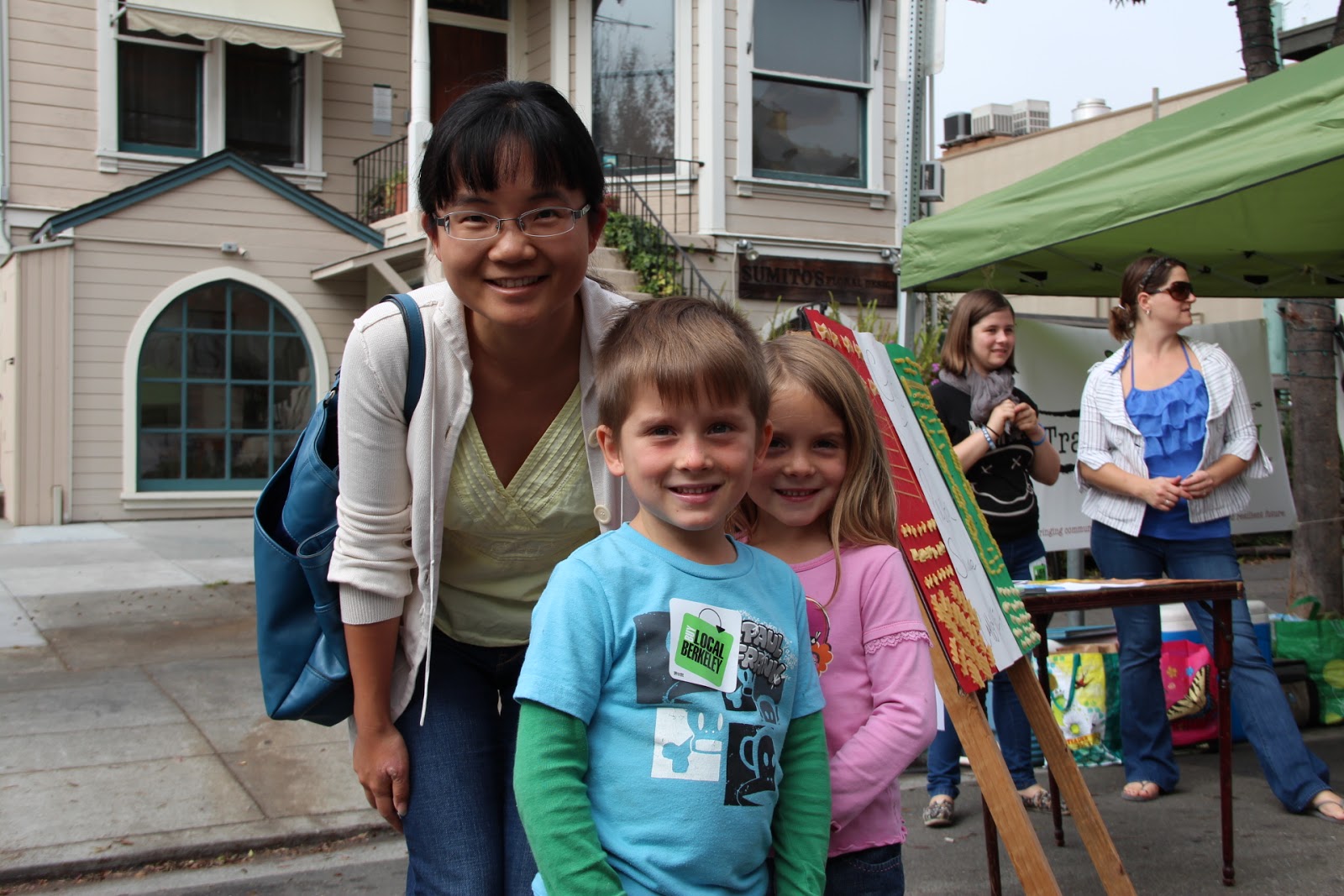
This Sunday saw the first Open Streets in Berkeley. Shattuck Ave was blocked from autos and reserved for the activities. Gang and I walked there at noon and looked around. It was nice to see so many people hanging out in weekends, and also quite exciting to get a taste of connections in a community.
 We arrived there at around 11:30am. Obviously the Sunday Streets in Berkeley followed a Berkeley time - i it was supposed to start at 11:00am, but very few people were wandering around on our arrival. We passed several vendors and campaign stalls before we found a tent to promote local communication. Two lovely volunteers, both around 5 to 6 years old, were distributing cards to pedestrians. They looked at you sincerely, and asked with that special children's tone: “Would you like to take a look?" No one could reject them. Yes they were probably the most successful flyers today.
At the cross of Shattuck Ave and Lincoln Street, a young lady was giving away her oil paintings for free. She showed me the oil paints and palette she was using, and the ideas of her painting. Her paintings had luscious colors and dynamic compositions. It looked like she enjoyed the creative work, as she said, "you can understand my paintings as you like." I didn't pick one on our way to the Cheeseboard, but when we were back, all her works were taken away. Not too far away from her, there was a face painting workshop where children were waiting in queue. A little girl just had her face painted as a cute cougar. Artists are everywhere.
 Interesting activities, such as a minivan theater, human-sized chess games on the floor (like the one in Harry Potter), Hula-hooping and Yoga classes, as well as drumming workshops, attracted big crowds, children in particular. But the highlight of the day was a pedal-powered concert. A band was playing music, with about 8 people, most of whom were volunteers riding bikes around to generate electricity for the audio equipment. Both Gang and I tried for a while. It might not be easy for one person to provide enough electricity supply for the entire performance. But since the crowd found this new green performance interesting, people kept joining in, and helped the performance continue.
After a big lunch at Cheeseboard, we headed back. Shattuck became more packed with pedestrians and cyclists. Children were having fun in different craft workshops and games; parents could relax with their fellows by looking at their children; all sorts of organizations seized the opportunity of advocating/opposing certain bills, and very luckily that the bay area is so blue that no one even bothered to campaign for Obama.

At the cross of Shattuck Ave and Lincoln Street, a young lady was giving away her oil paintings for free. She showed me the oil paints and palette she was using, and the ideas of her painting. Her paintings had luscious colors and dynamic compositions. It looked like she enjoyed the creative work, as she said, "you can understand my paintings as you like." I didn't pick one on our way to the Cheeseboard, but when we were back, all her works were taken away. Not too far away from her, there was a face painting workshop where children were waiting in queue. A little girl just had her face painted as a cute cougar. Artists are everywhere.

After a big lunch at Cheeseboard, we headed back. Shattuck became more packed with pedestrians and cyclists. Children were having fun in different craft workshops and games; parents could relax with their fellows by looking at their children; all sorts of organizations seized the opportunity of advocating/opposing certain bills, and very luckily that the bay area is so blue that no one even bothered to campaign for Obama.

Friday, August 31, 2012
Trip Planner
Gang's friend told us there are cheap flights to Hawaii recently. Since Gang's passed his qualify exam and I still remain jobless, we find now a good timing to do some traveling. When I recall all the travelings we've done together, Gang's always the idea-creator, and I'm always the trip planner.
The first trip (by trip, I mean more than 2-hour drive, which excludes San Francisco, point Reyes, etc.) we did together was to 17 miles. We didn't do any homework before going there. We drove along the sea with Strongy. It was freezing. The biggest discovery on that trip was Gang's infatuation with almond. I brought a can of nuts to snack on the way, and Gang kept asking me to feed him with almond when he was driving.
The next one was much longer. When my mum visited us in the summer, we went on a road trip to Las Vegas and then Los Angeles. This was the first time that I actually did plan a trip before setting off. The first step was to read other people's traveling blogs and to figure out where we would like to go. After determining the route, I started bidding hotels along the way, making sure each hotel was no more than 300 miles apart to avoid fatigue driving: for example, we stayed in Bakersfield in central California after visiting the Hearst Castle and left the rest 200 miles to Las Vegas for the next day. It was a great trip. I served as a tour guide with my cheat sheets which included highlights of scenic sites, attractions and restaurants.
After this nine-day trip, Gang and I took several other road trips to San Diego, Mono lake, Seattle, Grand Canyon and Arizona. Last summer, we stayed in Geneva and took several trips to our little neighbors - Lyons, Marseilles, Interlaken, Zurich, Lucern; and a longer train trip to Amsterdam, Bruxelles, Schloss Neuschwanstein, Munich, Rome, Florence, Venice and Milan. This year, we also rented a car and drove to Gettysburg and Lancaster in PA from Princeton, and later took a 10-day trip with mum and Joop to Niagara Fall, Buffalo, Pittsburgh and DC. I printed a 16-page trip agenda with two appendixes for my family, but I think only Joop was patient enough to read it.
Trip planning helps avoid some unnecessary spending. Even the same hotel can be priced differently on different websites, and some hotels have good promotions during a certain season while some overcharge customers during weekends. The prices of renting a car also vary across companies and pick-up/return locations. Booking things in advance reduces costs and saves time. When we were traveling in Vatican, I felt so lucky to have reserved tickets for the Vatican Museums and avoided queuing up for hours. Trip planning also provides a general flavor of the places I'm about to visit. Cities are more or less the same, but the stories behind them are quite different. If you're more interested in history and culture, trip planning can be very helpful in revealing the stories behind and spice up your journey. For national parks, you may want to better arrange your time and make sure you won't miss some highlights.
It's true that trip planning can take a long time. But I also find myself getting part of the joy in traveling from planning the trip. All those introductions about new places arouse my curiosity and make me more excited at the coming trip. Sometimes it's annoying to decide between too many choices when facing a limited time (like in Rome). Hum, maybe I should make this my job.

The first trip (by trip, I mean more than 2-hour drive, which excludes San Francisco, point Reyes, etc.) we did together was to 17 miles. We didn't do any homework before going there. We drove along the sea with Strongy. It was freezing. The biggest discovery on that trip was Gang's infatuation with almond. I brought a can of nuts to snack on the way, and Gang kept asking me to feed him with almond when he was driving.
The next one was much longer. When my mum visited us in the summer, we went on a road trip to Las Vegas and then Los Angeles. This was the first time that I actually did plan a trip before setting off. The first step was to read other people's traveling blogs and to figure out where we would like to go. After determining the route, I started bidding hotels along the way, making sure each hotel was no more than 300 miles apart to avoid fatigue driving: for example, we stayed in Bakersfield in central California after visiting the Hearst Castle and left the rest 200 miles to Las Vegas for the next day. It was a great trip. I served as a tour guide with my cheat sheets which included highlights of scenic sites, attractions and restaurants.
After this nine-day trip, Gang and I took several other road trips to San Diego, Mono lake, Seattle, Grand Canyon and Arizona. Last summer, we stayed in Geneva and took several trips to our little neighbors - Lyons, Marseilles, Interlaken, Zurich, Lucern; and a longer train trip to Amsterdam, Bruxelles, Schloss Neuschwanstein, Munich, Rome, Florence, Venice and Milan. This year, we also rented a car and drove to Gettysburg and Lancaster in PA from Princeton, and later took a 10-day trip with mum and Joop to Niagara Fall, Buffalo, Pittsburgh and DC. I printed a 16-page trip agenda with two appendixes for my family, but I think only Joop was patient enough to read it.
Trip planning helps avoid some unnecessary spending. Even the same hotel can be priced differently on different websites, and some hotels have good promotions during a certain season while some overcharge customers during weekends. The prices of renting a car also vary across companies and pick-up/return locations. Booking things in advance reduces costs and saves time. When we were traveling in Vatican, I felt so lucky to have reserved tickets for the Vatican Museums and avoided queuing up for hours. Trip planning also provides a general flavor of the places I'm about to visit. Cities are more or less the same, but the stories behind them are quite different. If you're more interested in history and culture, trip planning can be very helpful in revealing the stories behind and spice up your journey. For national parks, you may want to better arrange your time and make sure you won't miss some highlights.
It's true that trip planning can take a long time. But I also find myself getting part of the joy in traveling from planning the trip. All those introductions about new places arouse my curiosity and make me more excited at the coming trip. Sometimes it's annoying to decide between too many choices when facing a limited time (like in Rome). Hum, maybe I should make this my job.

Wednesday, August 29, 2012
A $700 Bill
I was reading Abenoseimei when receiving a mail from Aetna, my health insurance company. I visited my OB last month and got vaccination as she suggested. The bill I received cost me around $700, with the charge of vaccine at $70, the "administrative cost of vaccination" of $60, and an absurdly high cost of "office visit". It took me one and a half hours to appeal a review, which will take another 7-10 business days to give me feedback.
The health insurance system is one of the most confusing things in the US. It looks like that the hospital redefined my maternal visit to a "counseling" because the OB gave me some suggestions on pregnancy, which as a result excluded my visit from insurance coverage. I do hate reading the 30-page insurance policy and couldn't really figure out the differences between all sorts of visit. But I can't see how helpful it is to separate medical care from medical advice as both contribute to patients' health and address the same problems. Last year I came across a similar issue when I got food poisoned on the plane and was sent to emergency service after landing. The doctor was obviously too used to emergencies that she did not even show up until half an hour after my check-in. In the end I couldn't bear the pain anymore that I just asked her for some pain-killers. The unpleasant visit cost me more than $400. And now it surprises me again with a $700 bill for vaccination.
I remember when I saw a doctor in Beijing, it never took me more than one hour. I was informed of the payment before I decided to receive the medical care or not - if it was far above my budget, I could ask the doctor for alternatives. The insurance plans were much less complicated as well - you pay a certain amount at your visit, and a little more at pharmacy. The advantage is that you are fully informed of the charges, and there is no need to waste time on arguing against either the insurance company or the hospital; and the disadvantage is that some people are unable to get treatment because they can't pay at the counter. Of course it's too bad if lives are not saved due to financial concerns, but it's not less evil if people are deprived of the right to know how much they are to be charged.
As a warning, it's pretty risky to visit hospitals outside the school if you're covered by student health plans. I never paid a penny at Princeton Health Center, but when I saw a doctor in the bay for similar purposes the charges become ridiculously high. I suppose this is a different rule in this continent, inconvenient as it is, leaving me no choice but to better understand its functioning. I just switch to Gang's plan at Berkeley, which does offer a better coverage in the bay area and free access to health center in Berkeley (at a higher cost of course).
(This is a little bit off the topic, but today I also received a mail from superior court in Alameda County, asking me to appear for jury service next month. I'm not even a U.S. citizen! It's funny that I haven't enjoyed the rights of U.S. citizens but are already required to meet the obligations.)

The health insurance system is one of the most confusing things in the US. It looks like that the hospital redefined my maternal visit to a "counseling" because the OB gave me some suggestions on pregnancy, which as a result excluded my visit from insurance coverage. I do hate reading the 30-page insurance policy and couldn't really figure out the differences between all sorts of visit. But I can't see how helpful it is to separate medical care from medical advice as both contribute to patients' health and address the same problems. Last year I came across a similar issue when I got food poisoned on the plane and was sent to emergency service after landing. The doctor was obviously too used to emergencies that she did not even show up until half an hour after my check-in. In the end I couldn't bear the pain anymore that I just asked her for some pain-killers. The unpleasant visit cost me more than $400. And now it surprises me again with a $700 bill for vaccination.
I remember when I saw a doctor in Beijing, it never took me more than one hour. I was informed of the payment before I decided to receive the medical care or not - if it was far above my budget, I could ask the doctor for alternatives. The insurance plans were much less complicated as well - you pay a certain amount at your visit, and a little more at pharmacy. The advantage is that you are fully informed of the charges, and there is no need to waste time on arguing against either the insurance company or the hospital; and the disadvantage is that some people are unable to get treatment because they can't pay at the counter. Of course it's too bad if lives are not saved due to financial concerns, but it's not less evil if people are deprived of the right to know how much they are to be charged.
As a warning, it's pretty risky to visit hospitals outside the school if you're covered by student health plans. I never paid a penny at Princeton Health Center, but when I saw a doctor in the bay for similar purposes the charges become ridiculously high. I suppose this is a different rule in this continent, inconvenient as it is, leaving me no choice but to better understand its functioning. I just switch to Gang's plan at Berkeley, which does offer a better coverage in the bay area and free access to health center in Berkeley (at a higher cost of course).
(This is a little bit off the topic, but today I also received a mail from superior court in Alameda County, asking me to appear for jury service next month. I'm not even a U.S. citizen! It's funny that I haven't enjoyed the rights of U.S. citizens but are already required to meet the obligations.)
(Source: http://goo.gl/bTwt0)
Thursday, August 16, 2012
Days without Wifi
A day has passed since the modem in my apartment broke down. I can’t describe how terrible it is to live in a world without internet – it’s like a desert where you simply can’t get access to any information. I sat in front of the laptop, finding it useless and boring. I tried to do some cooking, and then realized I couldn’t refer to online recipes anymore. I wanted to write a blog, but I couldn’t use dictionary when having difficulties in expressing myself. Even if I planned to fix the modem, I didn’t know how to do it without online instructions. In short, everything sucks.
High-tech has shaped our lives so much that it’s hard to switch back. Now I can’t either process data or write drafts without online literature and database. But I used to write everything by hand in high school! I read hard-copy books, took notes of splendid words and insightful arguments, and tried to use them in my own writing. To avoid repetitive copying, I thought over every word before starting to write, and tried to make it as perfect as possible. Internet changes everything. Notes are largely unnecessary as almost everything can be found by Google; I no longer rely on my everyday life and traveling for new ideas, instead I browse Facebook and other social media to get information about other people’s lives. Deliberate writing is somehow outdated as updates can be easily done as well. But if internet is cut off and laptop is running out of battery, can I still write with a pen and a piece of paper?
Internet creates an attractive visual world in which things are both far away and familiar. We may bet that other internet users are people similar to us; however we are not certain of their identities, which is the most beautiful part of internet. Distance makes heart feel fonder, and internet caters to our illusion of mystery. We’d rather communicate with “guys on internet” than talking to real people in our lives. People seem to be much better at listening to strangers instead of building real relationship with acquaintances. We cite ideas from someone unknown and use them to argue against our friends.
All that said, internet cut-off is not purely evil, as it obliges us to go for our sub-optimal as we successful “resist” the temptation of wasting time online. Gang starts to read a book that he has been planning to for a long time, and I finish the latest Economist in a few hours which usually takes me days. Victims of the broken modem – me, my flat mates and neighbors who share the same modem with us, finally leave apartments and chat face to face, sharing recent lives with each other instead of sharing them on Facebook; and we all go to bed earlier because we “have nothing to do tonight.”
It’s depressing to think of how dependent we are of instruments and how weak we can be without them. We, the creator of these tools, are obsessed with the pleasure brought by them, can’t get rid of them anymore. That does not sound good. I want to be independent, I want to still enjoy my life even without internet, and I should be able to do so as I had successfully done that before.
Thank god I still have 3G on my iphone.

Saturday, August 4, 2012
Rivalries
How lonely France would be if there were no islands across the straight in the world! There wouldn't be a country with terrible food and monotonous life styles to laugh at. And so is for Britain: their comedies would be much less fun without jokes about snobbish French people. Rivals can be a mirror, reflecting your values and mistakes. With a mirror in front of you, you gain better understanding of yourself, which helps you grow. Laughing together for hundreds of years, Britain and France probably know each other better than anyone else in the world.
Same principles apply to Harvard and Yale, Berkeley and Stanford. During the annual football game between Stanford and Berkeley, all sorts of "insulting" cartoons will be posted around the campus to attack each other. There is also rumor that a Stanford professor once gave a lecture in Berkeley wearing a "Beat-Cal" T-shirt. Correspondingly Berkeley made a statue for a football coach who led his team to defeat Stanford for successive five years. These two schools have been beating each other for decades, each having a point.
Rivals are different from enemies. Beating enemies stimulates national or regional sentiment, while losing to enemies brings strong frustration and arouses revenge. Victory over rivals also creates fabulous pride for one's alma mater, but failures do not hurt that much. This is the beauty of competition between rivals. Rivals, though reluctant to admit friendship between each other, view them more as friends rather than enemies. Losing to friends can be regretful, but not resentful. That's why failures to rivals can generate positive motivations out of negative results.
But there is no clear cut-off between rivals and enemies. If you only want to defeat someone, you're probably rivals; but if you want to smash someone, you're more likely to be enemies. When people's attitudes towards each other change, their view on the counterpart's role will change as well. Britain and Germany used to be enemies, but became more rival-like after WW2.
Thus in the same competition, people do feel different when they lose to different people. It's very interesting to think of Olympics in this way. Athletes all over the world compete against each other, and audiences cheer for their domestic players. If you have to lose, who you'd rather lose to? Losing to a rival is not fun, but you can attribute it to the marvelous progress that your rival has made since its last failure. Losing to an enemy is much worse, it may suggest a transfer of power from "us" to "them".

Same principles apply to Harvard and Yale, Berkeley and Stanford. During the annual football game between Stanford and Berkeley, all sorts of "insulting" cartoons will be posted around the campus to attack each other. There is also rumor that a Stanford professor once gave a lecture in Berkeley wearing a "Beat-Cal" T-shirt. Correspondingly Berkeley made a statue for a football coach who led his team to defeat Stanford for successive five years. These two schools have been beating each other for decades, each having a point.
Rivals are different from enemies. Beating enemies stimulates national or regional sentiment, while losing to enemies brings strong frustration and arouses revenge. Victory over rivals also creates fabulous pride for one's alma mater, but failures do not hurt that much. This is the beauty of competition between rivals. Rivals, though reluctant to admit friendship between each other, view them more as friends rather than enemies. Losing to friends can be regretful, but not resentful. That's why failures to rivals can generate positive motivations out of negative results.
But there is no clear cut-off between rivals and enemies. If you only want to defeat someone, you're probably rivals; but if you want to smash someone, you're more likely to be enemies. When people's attitudes towards each other change, their view on the counterpart's role will change as well. Britain and Germany used to be enemies, but became more rival-like after WW2.
Thus in the same competition, people do feel different when they lose to different people. It's very interesting to think of Olympics in this way. Athletes all over the world compete against each other, and audiences cheer for their domestic players. If you have to lose, who you'd rather lose to? Losing to a rival is not fun, but you can attribute it to the marvelous progress that your rival has made since its last failure. Losing to an enemy is much worse, it may suggest a transfer of power from "us" to "them".

Tuesday, July 24, 2012
Another Sunny Day
No one could complain about the weather in the bay area. With a temperature ranging from 55F to 75F, it seldom surprises people with sweating summers or harsh winters. If you travel in the bay area in January and visit it again in June, you'll find the temperature amazingly similar: the average temperature in Jan 2011 was around 60F, which increased to 68F in June (source: http://www.wrh.noaa.gov.) You can hardly notice the changes. Every day is similar to the day before: pleasantly cool. It rains sometimes in the winter, but never chilly. All you need is a t-shirt, a windbreak and jeans for all year round - no skirt, no boots, no down jacket.
Nowadays we have air conditioners (ACs) which create a spring-like weather indoors, and sometimes we had the illusion that ACs can help us adapt to the weather. Even if we're living in desert, we can still have 75F summers - like in Las Vegas, as long as we stay in the casino, we can't really tell whether it's hot or cold, day or night. However, ACs are not real solutions. On contrary, they make us more fragile to the weather outside. Once we're used to the AC's accompany, the blazing sun outside looks even worse, which in return discourages us from going outdoors. This may partly explains why Las Vegas earns so much from its visitors - the longer you spend in casino, the less likely you're willing to leave.
This is exactly how I feel about the bay, where there must be an invisible AC which functions day and night without any noise, and keeps the temperature within the comfort zone. I always find sunny days much more delightful than gloomy ones, and it's a great treat to wake up with sunlight touching my face in the morning (or noon in my case.) As a result, I feel blue when it sprinkles, and complain about the heat when it reaches 80F. It's so easy to get spoiled in the bay area that I strongly missed this place when traveling. Marseilles is too hot, Geneva is too humid, Seattle rains too often and the east coastal cities are just unbearable. All the natural landscapes, historic sites and gourmet are much less attractive when you're sweating or wetting. Many people don't realize the importance of pleasant weather until they have really enjoyed it, and then they can't go back. I'm one of them. I never realized that I'd be so sensitive to weather. I have lived in cities who are notorious for its severe winters and mid-summers, I survived in tiny rooms without AC or fan. But now, I don't think I can do that any more.
It's sad to find myself under such a constraint of location while it's always said that young people should bravely explore the unknown world and travel all around. Nice weather also deprives me of special joys in midsummer. When I was in Beijing, where temperature can reach as high as 110F in July, my favorite dinner in summer was cold watermelon, which I believe is a master piece of God designed specially for scorching summer. Gang and I got a watermelon here a few weeks ago, but were still not able to finish it. It's not surprising that we both lacked the appetite for cold watermelon when the temperature was around 65F. Swimming seems less fun too. I used to go swimming at noon and find cool water very enjoyable during the heat of the day. Berkeley has swimming pools too, but much less attractive with its cool weather. People also complain about how boring the bay area can be because there is hardly any change of natural scenes in lack of the changes of seasons. Fall is probably a little different from the rest as the leaves are changing, but basically I can only tell the seasonal transition through calendars, dishes in restaurants and apparel discounts.
All this said, I'm not leaving this place. Born and lived in places with distinct seasons for years, I now appreciate this gift of nature.

Nowadays we have air conditioners (ACs) which create a spring-like weather indoors, and sometimes we had the illusion that ACs can help us adapt to the weather. Even if we're living in desert, we can still have 75F summers - like in Las Vegas, as long as we stay in the casino, we can't really tell whether it's hot or cold, day or night. However, ACs are not real solutions. On contrary, they make us more fragile to the weather outside. Once we're used to the AC's accompany, the blazing sun outside looks even worse, which in return discourages us from going outdoors. This may partly explains why Las Vegas earns so much from its visitors - the longer you spend in casino, the less likely you're willing to leave.
This is exactly how I feel about the bay, where there must be an invisible AC which functions day and night without any noise, and keeps the temperature within the comfort zone. I always find sunny days much more delightful than gloomy ones, and it's a great treat to wake up with sunlight touching my face in the morning (or noon in my case.) As a result, I feel blue when it sprinkles, and complain about the heat when it reaches 80F. It's so easy to get spoiled in the bay area that I strongly missed this place when traveling. Marseilles is too hot, Geneva is too humid, Seattle rains too often and the east coastal cities are just unbearable. All the natural landscapes, historic sites and gourmet are much less attractive when you're sweating or wetting. Many people don't realize the importance of pleasant weather until they have really enjoyed it, and then they can't go back. I'm one of them. I never realized that I'd be so sensitive to weather. I have lived in cities who are notorious for its severe winters and mid-summers, I survived in tiny rooms without AC or fan. But now, I don't think I can do that any more.
It's sad to find myself under such a constraint of location while it's always said that young people should bravely explore the unknown world and travel all around. Nice weather also deprives me of special joys in midsummer. When I was in Beijing, where temperature can reach as high as 110F in July, my favorite dinner in summer was cold watermelon, which I believe is a master piece of God designed specially for scorching summer. Gang and I got a watermelon here a few weeks ago, but were still not able to finish it. It's not surprising that we both lacked the appetite for cold watermelon when the temperature was around 65F. Swimming seems less fun too. I used to go swimming at noon and find cool water very enjoyable during the heat of the day. Berkeley has swimming pools too, but much less attractive with its cool weather. People also complain about how boring the bay area can be because there is hardly any change of natural scenes in lack of the changes of seasons. Fall is probably a little different from the rest as the leaves are changing, but basically I can only tell the seasonal transition through calendars, dishes in restaurants and apparel discounts.
All this said, I'm not leaving this place. Born and lived in places with distinct seasons for years, I now appreciate this gift of nature.

Subscribe to:
Posts (Atom)