Tuesday, November 13, 2012

Digital Era

Probably no one has expected an investigation of Ms.Kelly's email account would result in the resignation of the C.I.A director. This is another typical lesson about how private information can be leaked in an information era. Internet seems to be good at preserving information for a long time, even if you mean to discard it. When people search information they may come across some surprises, just as what the F.B.I found out this time.

Actually email is far from the biggest trouble, at least normal people won't have access to your email account and your correspondence should be relatively safe, unless the Big Brother keeps an eye on you and the email service provider spinelessly concede; or like in this case, they get your permission to check emails. Private information can be collected in a much easier way. Social media and smartphones make it much easier for people to share their thoughts, status and locations in the public as long as there is wifi or 3G/4G. People always like to talk about themselves, therefore it's not surprising to see how much information can be collected from one's facebook and twitter account. And to gather this information, you don't need any search warrant or permission, Googling is enough. I have some Facebook friends that I've never met, but I do feel like knowing them for a long time - I know their families, friends, hobbies, education background, work, and even weekend plans even though I never intentionally do the research, all the information just appears automatically on my Facebook timeline. When we meet in reality, we talk like old friends.

It's nice to start a conversation with a real life stranger who happens to be a Facebook friend by avoiding unpleasant topics based on what you learned from his/her Facebook, but problems are created in the same place. We're happy to share information within certain groups, but may not want to be heard by outsiders. There was a kidnapping in China months ago when the criminal collected information about the kid from his mother's Weibo account, an figured out the best timing and place to take him away. Another case reported by a Weibo user also showed that traditional phone fraud also improved its performance by providing more detailed information of children when swindling their parents: he planned a trip to Japan with his girlfriend, and was very excited to share his plan on his Weibo. During his trip in Japan, of course he turned his Chinese cellphone off, and his parents and friends in China were not able to reach him. That was when frauds called his parents, saying he got in trouble and needed money to come back. Luckily his parents didn't buy the story and freed themselves from monetary loss, but they still suffered a lot from anxiety. Private information can induce great damage if it's obtained in the wrong hands.

There is a grey area between private lives and public ones, where the private information can be shared with the public but does not have to. In a digital era, there are tons of tools to fill up the grey area. You may not want to mention pillow talks on Facebook, but you probably will upload a weekend hiking photo there, and you never know how those browsing your Facebook will find out about you as fragmented information like this build up. We can't blame the tools for being too convenient to leak private information, as it's us who decide the line for disclosure. At Princeton, we were warned to take off all the "improper" photos and comments on Facebook by the career adviser who strongly believe interviewers will check candidates' profiles before talking to them. I guess that's Ann was trying to tell us: no one is perfect, so don't be so eager to show people everything.

http://goo.gl/VVqTv

Monday, November 12, 2012

Gossips in The Economist

The Economist has become one of my major information sources in the US. I was excited when it started a special column on China this summer. Though the new section on China is only a page long, but it covers a wide range of topics, introducing social, economic and business issues in China. Some reports, like the one on Inner Mongolia, even surprised native Chinese like me. A few months have passed, and I've noticed an interesting trend when The Economist digs hotspots in China, which is to quote posts on Sina Weibo, the most popular social media in China as both Facebook and Twitter are blocked in the continent.

I agree that surfing online is a good way to observe what some Chinese people are concerned about. And Weibo, thanks to its huge usergroup, does include many interesting stories in China. However it's problematic to rely so heavily on Weibo as an information source. For example, in the latest Economist, there is a small piece called "Congress Watching" with a subtitle "Heard in the Hutong". As the title indicates, it's a gossiping piece, most of overhearings are posted by Weibo users. Among them is a taxi passenger who complains about the removal of all taxi window handles in Beijing according to a government directive in the name of security. The passenger wrote on his Weibo that the he was suffering from the driver's fart during the ride because of the closed window. It was a funny post on Weibo and went viral soon. I had a big laugh when reading it on my Weibo, however I found it weird that The Economist chose to re-post it in its newspaper. Given a more than $100 subscription fee per year, I guess I'm probably expecting more than gossips from The Economist.

In The Economist, pieces on China and other developing countries are very different from those on OECDs. When it talks about the US and EU, it does a good job in integrating small stories into big ideas with analytical statements. But when it talks about China, articles are most detail-oriented, filled with micro-observations rather than analysis. If I think about how Chinese media report foreign news, I think The Economist does a great job in reporting China; but if we raise the standard a little bit, let's say there is still room for improvement.

First comes the question of research methodology. When you want to introduce a country where the information is opaque, the data is always wrong and interviewees don't tell the truth, what should be a possible approach? Even in academia, most scholars working on China have problems in applying the same methodologies used by their OECD-focused counterparts due to the lack of public information, and have to rely more heavily on informal channels, such as personal connection with insiders and social media like Weibo. The difficulties of conveying timely information are foreseeable for journalists in China. However the piece on Wen's hidden wealth in NYTimes shows that in spite of the above difficulties, valuable discoveries can be found in publicly available information sources. David Barboza, the reporter, claimed to the gather all the data in his piece from public sources, but it took him more than a year to process all the information and finally find out the truth. When the information is half disclosed and mixes truths and lies, it's not easy to ferret out the facts. But isn't that journalists' job?

Then comes the concern about accuracy. When you can't get a full picture of facts, but fragmented pieces from a jigsaw puzzle, it's vital for the journalist to infer like a detective. And that's when mistakes can happen. It's crucial to have the news correct, therefore it is a natural choice for journalists to play conservative and report "unbiased" fragments only. However it always makes sense to add some analysis, no matter how accurate it can be, the reasoning will help the audience think and understand better. I once worked with an archaeologist, and most of his work is trying to put pieces together in a puzzle to depict history, which includes a lot of assumptions and deductions. He can make mistakes, but that never undermines his reputation as a great archaeologist. Journalists who make up news to attract eyes are despicable, but a few reasoning that help audience build up the full picture should be awarded.

I still like The Economist, just don't feel that happy paying for Weibo Briefs every week.

http://goo.gl/5n4W9

Sunday, November 11, 2012

Delegates

The ongoing 18th CCP Congress gathered more than 2,000 CCP delegates across China, who will vote for the leading group in China for the next decade. The CCP members count for 5% of the Chinese population, but the 2,000 CCP delegates are to decide the future of 1.4 billion people. These delegates go to Beijing every five years, dawdling for a week at the cost of tax payers' money, doing anything but their job. In the end, a few old people make final choices, and these delegates act as rubber stamps and hooray their decisions.

In theory, these delegates represent all the 80 million CCP members and are entitled with the power to determine the next leading group of China. But we all know they're hand picked. In general, the CCP delegates are considered as "elites", including CEO of state-owned companies, presidents of academic institutions or high-level government officials. They go to Beijing, fully informed of how little they can affect the conference outcome, but always enjoy this great networking opportunity which can build up their "guanxi" with the central committee. Not surprisingly, some recent released stories show that these delegates care little about policy, but are more keen to show their loyalty to the Party. Instead of making comments on Hu's 100-min speech or the Party's Constitution Amendment, delegates from Ningxia Province talked about how frequently they were thrilled into crying during the congress when they found the Party is "so clean and pure"; and another old delegate proudly told the journalist that she supported the CCP's policy by never voting against it - as most other delegates did in the past half a century.


To many people's surprise, even these rubber stamps are carefully selected. I worked for a small non-communist party before, and never had the opportunity of getting involved into CCP's issues. But I once worked with some colleagues to interview National People's Congress (NPC) delegates, who by law are the counterparts to the US Congressmen, but are powerless in China. Just like their peers in CCP, the NPC delegates meet every five years to elect the national leaders, which of course are determined by the same group of old guys. But to guarantee the NPC delegates will "behave well" and pass every personnel decision, bill or amendment, it's vital for the central government to screen all the NPC candidates and make sure invitation only goes to those they like. To demonstrate the participation of non-communist parties in state affairs, non-CCP members are always invited to help select NPC delegates. I once worked as the representative of my party in the selection committee, and interviewed 20 candidates. I followed the selection criteria, talking not only to the candidate, but also his colleagues and supervisors - a typical way of collecting comprehensive information about a candidate in the CCP. After quite intense interview, my group reported our final recommendations, which were presented to NPC central committee for their final decisions. Usually 92% of the recommended candidates will get a one-week vacation and a free trip to Beijing.

My friends at Princeton can be very excited at meeting or working with a Congressmen/Senator, while I find it ridiculous that I actually did interview some "Congressmen" in my country, which unfortunately shows how powerless the NPC is in China. No one can confidently say what policy will be like in China in the next decade, and all we know so far is that Xi Jinping and Li Keqiang will announce themselves the next CCP President and vice-president in four days, Bo Xilai and his allies won't have any chance in the game, and tax payers will continue paying the bill.

Saturday, November 10, 2012

Painting

The rainy season has arrived in the bay area, making indoor activities much more attractive than before. Carol and I planned to hang out in the afternoon in her place, doing some painting and crafting. We did this several times at Princeton when trying to escape from pressure in the real world. Playing arts while gossiping seemed very effective in relieving stress. Although most people prefer painting with pigments, but I always feel more comfortable with lines. Once I copied a sketch from Uffizi Gallery, showing a girl serenely looking down with a little smile, lost in her own thoughts. We spent about two hours painting and chatting on that Friday night. Carol made a painting of the Twin Peaks with oil pastels, Leslie made a painting of a waterfall and a tourist with charcoals, and I did this one with a pencil. Sketching is easy and flexible: it's easy because I can present all my imagination with just a pencil; and it's flexible because I don't need to worry if I accidentally make mistakes during the painting, a few more lines can fix the problem. Therefore it's always my first choice when painting. As many other painters, I start with portrait, and feel more comfortable with faces than bodies. (I know nothing about anatomy.)

Drawing cartoons can be even easier - no worry about light and shade, and all I need is to delineate the outline and then fill up details. When I'm facing a tight time budget, like one hourish, cartoon is always the best choice. The portrait of Shaka, a character in Saint Seiya on the left took me less than 30 minutes. I was chatting with Gang when drawing. Sometimes I believe that drawing is a processed in a separate part in our brains from thinking as I can think over during the conversation while drawing something totally irrelevant.


Later I bought some crayons at Walmart at around $4, and tried to color some of my paintings. I did a portrait of Okitasougo, a character in Gintama. He has light brown hairs and black eyes, and always wears a dark purple uniform. This picture is about him getting angry, which turns his eyes into scarlet. Crayons help to create a more colorful world, but lack the freshness and softness in oil painting or gouache, which make the color look less authentic. If not applied well, crayons can cover the original lines and make the final product even worse than the sketch. But I slowly get a sense of coloring through these crayons.

After I have a better idea of colors, I try to use them more. This time when I did painting with Carol, I tested oil pastels in traditional Chinese painting. In general oil pastels have brighter and stronger colors than crayons: actually they are so strong that sometimes it's hard to tell whether a painting is performed with oil pastels or brushes. I enjoyed the experiment very much, and for the first time in my life I realized that traditional Chinese paintings can be copied without brushes. Later I looked at more similar paintings, and found that traditional Chinese paintings rarely have strong colors, but prefer to create room for imagination through light colors and clear lines. It came to my mind that I should use crayons instead of oil pastels. That was why I decided to paint "Mountain Streams and Pines" (松涛山涧) as below. Crayons are unable to show details (they're just too thick), but can do a good job in light coloring, which is exactly what many Chinese landscape paintings are about - or in their words, the art of space.

Thursday, November 8, 2012

Happy Birthday, Milo

27 years have passed since 1985 when Shueisha started to serialize Saint Seiya (SS) by Kurumada Masami, one of the most influential comic artists in his days. Five years later SS was animated and won hundreds of thousands of young audiences in China after the CCTV bought the its copyrights. In days when Chinese cartoons were far less developed, SS attracted many Chinese children with its glaring pictures and extraordinary characters. Almost every student in my class watched it, and knew fictional things like "burn my cosmos" or could do a few fighting moves. I was one of the kids, and inevitably I got obsessed with SS for years. But my dad didn't allow me to watch SS too much for fear that the glaring pictures would hurt my eyesight.

20 years later, Chinese cartoons were still as poor as two decades ago, but Japanese cartoons were much more developed, and many of them were introduced to the Chinese market. The new cartoons made the SS look like a rough and childish one to its old audiences, who were young adults now. But the SS as part of our memories of childhood, is always missed. That was why they made Saint Seiya Hades, a new series of SS with better computer-made stunts and more gorgeous pictures. (Actually it was the most expensive TV- animation at that time.) In comparison to the old SS which was mainly about Bronze Saints, the new episodes were more about Golden Saints who are also stronger and prettier. This time I was a college student. I watched SS Hades with other SS fans, not worrying about its glaring pictures. The new SS Hades created a strong reminiscent mood among SS fans. New online forums, clubs, cosplays, fan comics and novels could be found everywhere. Even I ordered a SS T-shirt from the fan club in Peking University.

After the SS Hades, Golden Saints beat their Bronze peers and lead the popularity rankings, and one of the most popular Golden Saints is Milo, the Scorpius Saint. He is the youngest one in all the twelve (and later thirteen) Golden Saints, and is also viewed as one of the most emotional and caring saint in the SS. His fans always celebrate his birthday on Nov 8, based on officially released bios. In 2004, I drew a short comic about his birthday, the only comic I've ever made. One year later, I put all my fan novels of Milo into a book, and then decided it's time for me to grow up.

The moment of SS has largely gone. Its following episodes never became popular as the SS Hades. Now most SS online forums are closed, few people are still drawing or writing about SS. Days when we got together to celebrate Milo's birthday will never be back. But Japanese cartoon fans are still growing, with more new animations showing every season and old ones never coming to an end. As long as this industry grows and the Chinese cartoons continue sucking, there will be more Chinese children and teenagers becoming Japanese comic fans, and crazy about the characters in them. You can call this a cultural invasion, but I need to say cultural products like this are truly powerful.

Scorpio Milo

Wednesday, November 7, 2012

Election Day, None of My Business

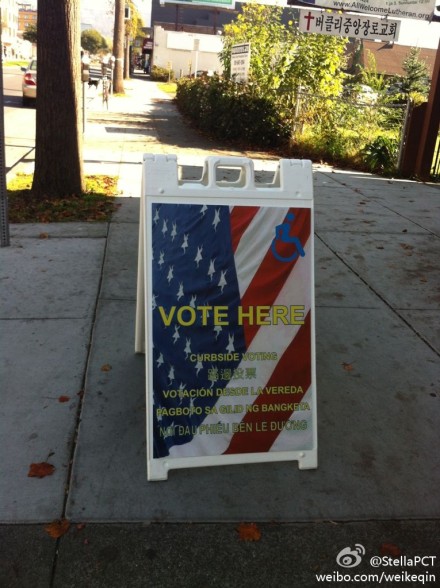
Yesterday morning I went to a polling place in Berkeley to watch people voting. As someone who has no say in leadership change in my own country, I'm a jealous observer of what's happening in the US. The polling place was located in a small church on University Ave, with a billboard saying "Vote Here" in English, Spanish, Chinese, etc. People stayed in the short line, quietly waiting to vote. They're lucky to live in California, a deep blue state, therefore they didn't suffer much from ubiquitous campaign ads like in Ohio. People are voting, but are not crazily mobilized to vote. They came here as a stop to work or a lunch break, and checked the box after Obama and Biden.

Democrats' victory in White House looked almost certain before the ballots were counted. Despite the poor performance on economy, Obama seemed to have persuaded voters that Romney could only lead the country to a worse situation. Electoral forecasters on Intrade.com believed the odds for Obama's re-election vary between 60% to 90%. Sandy is the last straw that crushes Romney, as FEMA showed its strong disaster-relief capacity and the NJ governor praised Obama for his reaction to the hurricane and afterwards reconstruction. At least I never doubted that Obama could get re-elected when I heard Romney talking about opening windows on airplane and the 47%. But many of my American friends, those working on environment and energy issues in particular, were truly nervous before the result was released. I guess this is a true reaction when politics is closely related to your everyday life.

Tomorrow the 18th National Congress of the Communist Party of China will take place in Beijing. It's a party congress, not a national congress. However it will determine the Chinese leading group for the next ten years. We already know who the next CCP chairman, i.e. the next Chinese president will be, and we are also pretty sure who the next Chinese premier will be. But the rest seven vacancies in the central politburo standing committee remains opaque. 800 million CCP members are not able to vote, let alone the 1.3 billion non-communists. A small group of old men decide what China will be like in the next decade. Since I have no clue about what policy options have been debated within the decision-making body, or which policy/politician I should prefer, I'm not nervous at all. I will just wait and see, and probably guess what policy will be adopted in the future.

The beautiful part of checks and balance is to put restrictions over power, therefore incumbents have to carefully watch their behaviors and do less wrong. The relation between the government and the public is like a multiple gaming, with each side trying to gain more. Yes democracy makes mistakes, but the political party and politicians who made the mistakes never had a second chance. While in dictatorship, there is no restriction over the power, and dictators can do anything to maintain their rule, such as lying about history, suppressing dissents and blocking internet. As a result, the public lose the second chance to know the truth. If we try to model these two political regimes, in democracy, both the public and the government have utility functions out of which they try to maximize their utilities; while in dictatorship, only the government has a utility function while the public is a condition to subject to.

@ University Ave, Berkeley CA

Monday, November 5, 2012

Lost in BART, and Everywhere Else

This afternoon I took BART back to North Berkeley from Lafayette. I should first take the train to SF, transfer at MacArthur and then another train to Richmond; and I did plan to do so. However when I got off one platform and headed for another at MacArthur, I made a mistake - instead of catching the train to Richmond, I got on the one back to Pittsburg. (And I strongly believe putting two platforms so close is a design flaw.) It was very crowded on the train, I finally found a holder and stabilized myself. I didn't realize my mistake until I got to the next station. Frustrated but amused, I got off the train and went back to MacArthur again, where I finally figured out the right platform for BART to Richmond and got home in the end.

This was not the first time that I got lost in BART. About one month ago, I took BART from Powell Street to North Berkeley, and was messed up by a misleading timetable which led me to the wrong train. I was obsessed with reading on the train, and didn't realize what was going on until Gang called me, saying I was on the wrong train. Obviously he tracked my place with "find my iPhone", and found his wife going somewhere unknown. Warned by Gang, I got off the train and returned to MacArthur where I found the right train to ride on.

BART is probably one of the most convenient transportation in the bay area, and therefore I only lost twice on it. Buses are much more confusing. When I was living in the south bay, I once saw Gang off in the Caltrain station. Later I took a bus home. Though I had studied its path carefully before making the "trip", I still got off the wrong stop, and had to walk another ten minutes back. Coincidentally Xujing has witnessed my poor sense of direction during her visit to Stanford University as well. After showing her around the campus, we took a campus shuttle to the Caltrain station. Unfortunately though I got the name of the line right, I got the direction wrong. Instead of going two stops, we had a great shuttle tour of the campus and arrived at the Caltrain station more than half an hour later.

For people like me, map is nonsense. I noticed this when I went to college in Peking University. on the first day, all my roommates had no difficulties with walking to classrooms with a map except me. Later my roommate took me to classroom everyday until I was able to do it by myself about two months later. Years ago, I once showed Xinxin around Stanford with a map during her visit, which however didn't give me a clue about the locations of several places. Anyway I guided her for quite a while but had to admit I was lost in the end. So Xinxin took the map over and showed me the way back to bus stations.

What makes google map on smart phones so precious is that it shows your real-time location on map. Ever since I had that iPhone 4, I never got lost on Princeton campus, although it took me a few months to be able to walk to Robertson Hall from GC without referring to iPhone, and I did once have a difficult time to go back to Magie because even the roads on google maps were very confusing. Another invention that I'm very grateful of is GPS navigation systems in cars. I used GPS everytime I drive, even to a Safeway which is 1 mile from my apt. The logic is that if I can't tell directions when I'm walking, there is no way for me to tell directions when I'm focusing on driving.

I had some problems in finding ways abroad when 3G on my iPhone was blocked, but luckily I was always traveling with someone who could tell directions. So far I didn't make a single emergent call for help with road guidance. So at least there is something that I can be proud of.